Category Archives: Shop made tools

Shooting plane pregnancy

15/08/2013

This will be the first of a new type of post I am planning to do. I will post updates on each project as I progress. In other words, writing the post while I build the object.

The plan is to start building a dedicated shooting plane and shooting board. Below you can see the rough sketches I made while on the airplane this past weekend. The wife and I flew down south to attend the 90th birthday celebrations of the best rugby school in the history of the game. Outeniqua of course.

The idea with this plane is to slope the sides of the plane in order to skew the cutting edge of the blade just enough to create a slight sheering cut. The plane will slope down to allow the angled cutting edge to jam the stock that is being cut down into the corner created by the floor and the rail of the shooting board, rather than potentially lifting it. I am also playing around with ideas to potentially have a way to use the plane on both sides of the shooting board while still ensuring a comfortable grip. You can join me as I design and build the plane over the few weeks/months.

Shooting plane design

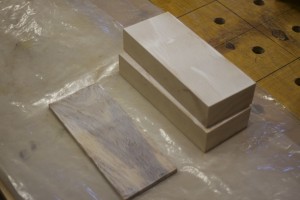
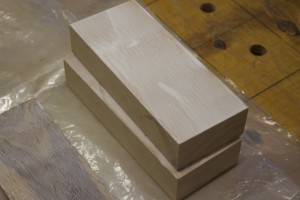
19/8/2013 – I started off with the shooting plane this weekend. I prepared the stock of the Shooting Plane together with that of a 30″ Jointer, a 22″ Fore Plane and a 17″ Jack Plane from the two boards seen below. In these pictures they are fresh out of the Planer.

IMG_7619IMG_7620

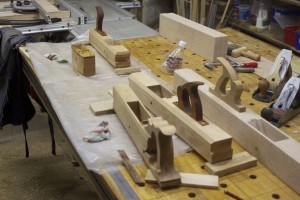
Here you can see the parts of the Jack Plane (left) and the Shooting Plane (right).

IMG_7631


I used my bandsaw to re-saw some ysterhout for the sides of the Shooting Plane and the soles of the other planes. I then processed it further in the planer.

IMG_7625IMG_7626IMG_7627

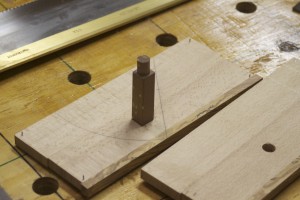
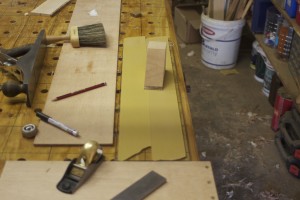
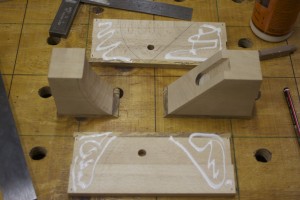
I made a few drawings on the stock to test the ideas I had as seen in the rough sketches in the first picture.

IMG_7633IMG_7634

Here you can see the ysterhout sides of the Shooting Plane posing with the yet-to-be laminated beech stock.

IMG_7635

The same ingredients with their cousins-to-be as mentioned.

IMG_7636

I utilised most of my current arsenal of planes to prepare the beech stock for lamination.

IMG_7641IMG_7642


As I already used up most of my clamps for the Jack Plane’s lamination, I employed my face vise in tandem with a few random C and F-style clamps to laminate the Shooting Plane on the same day.

IMG_7643

3/9/2013 – Please be patient as I am currently working on the three planes that look similar apart from their length. I will get back to the shooting plane once these are finished.

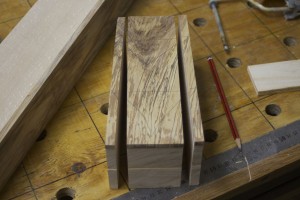
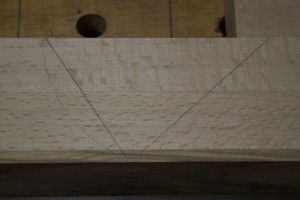
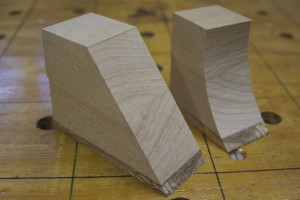
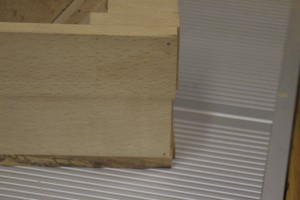
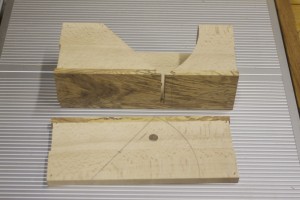
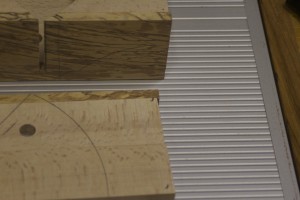
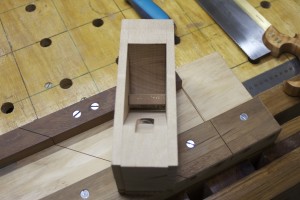
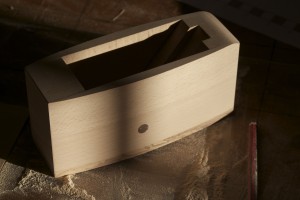
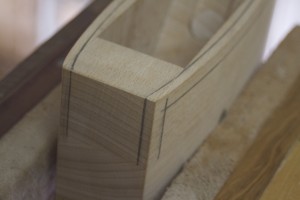
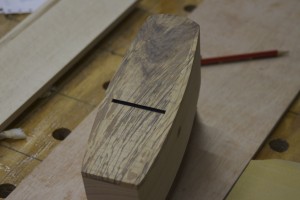
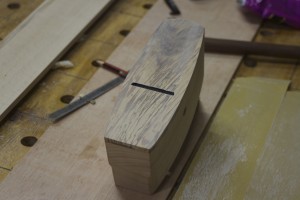
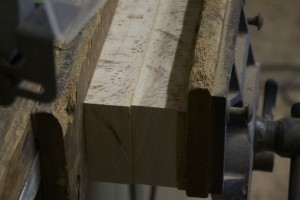
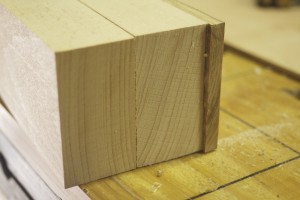
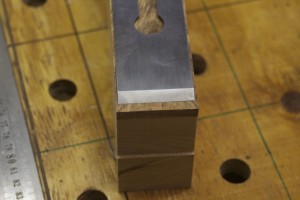
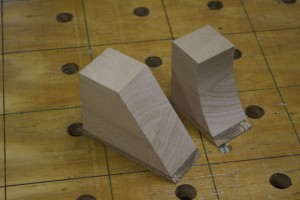
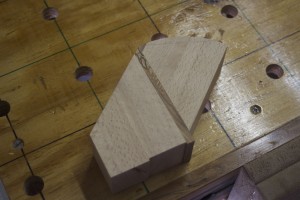
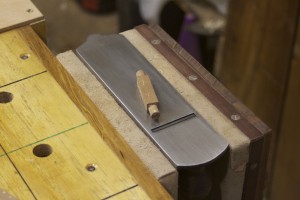
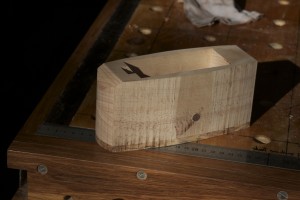
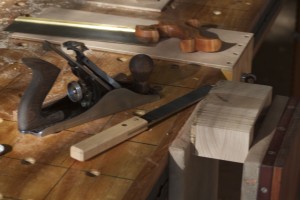
14/10/2013 – Finally I managed to do some work on this project over the weekend. You can see how I sliced the beech blank creating a triangular centre piece, it’s two sides and the two triangular bits of waste. The plane has this odd shape to skew the cutting edge by about 7º creating a slight sheering cut.

IMG_8168-2IMG_8169-2


The rough-sawn sides of the centre piece were flattened by alternating use of the Lie-Nielsen low angle Jack Plane with a toothed blade and my own shop made Jack Plane. The final touches were done with the longer Fore Plane (also pictured).

IMG_8170-2IMG_8171-2IMG_8172-2IMG_8174-2IMG_8175


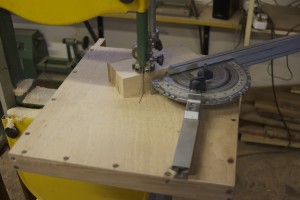
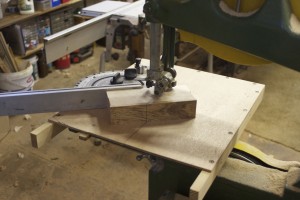
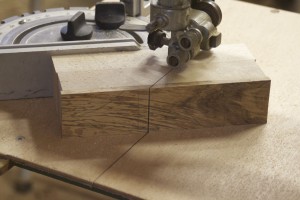
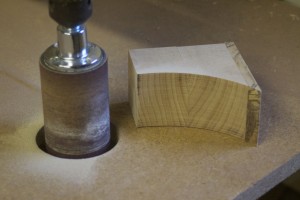
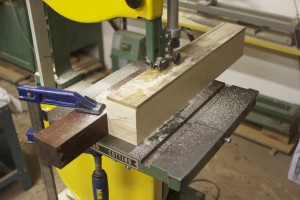
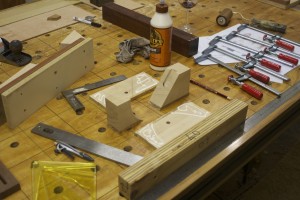
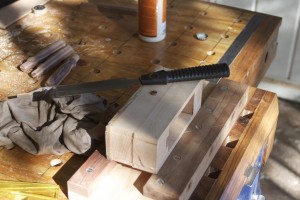
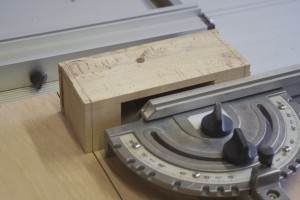
In order to cut the ramp in the centre piece, I had to come up with the setup below in addition to using my shop made bandsaw mitre-sled. I wrote an entire post on how the sled was built, which you will find under the category “Jigs”.

IMG_8176-2IMG_8177-2IMG_8178-2IMG_8179-2IMG_8180


IMG_8181-2IMG_8182-2IMG_8183-2

IMG_8184-2IMG_8185-2IMG_8186-2

IMG_8187-2IMG_8188-2IMG_8190-2IMG_8191-2

Wooden plane-building tip

As you might have noticed I am in the process of building a series of wooden planes at the moment. I spent at least 8 months collecting info in the form of a book, a DVD, heaps of articles, and dozens of Google images on the topic. During this time I also consulted (and still do) my number one source of sound woodworking advice in the form of Deneb Puchalski of Lie-Nielsen.

During the last few days before diving into the actual building process, I made up a Word document with the most pertinent bits of information such as measurements for the positioning of the cross-pin, positioning of the toe and heel piece relative to each other, etc etc. I then printed it and got it laminated as you can see in the pictures below. I keep the two pages (actually four if you consider that they are printed on both sides) of information on my assembly table while I work away at the planes. It is very handy to simply lean across to check a particular measurement or what ever the case might be.

I deliberately did not take close-up photos for fear of violating copyright, but I guess you can get the idea. Anyway, in terms of measurements, I found the article entitled “Wood planes made easy” by David Finck in Fine Woodworking Magazine (January/February 2008 page 72-77) very helpful and it forms the bulk of my document. He also wrote a book entitled “Making & Mastering Wood Planes”, which would be good to get hold of.

IMG_7242IMG_7241

Glue roller

A problem I have encountered as a result of the very dry climate (ambient humidity 30-35% in my shop during winter months) and frequently needing to laminate heaps of small pieces of wood together has been the short open-time of the PVA glue I use. The reason why I need to laminate is the nature of the hardwood boards I have. There are very few of these boards that one can use as is. For most of them I need to cut a whole heap of smaller pieces to make up bigger ones by lamination. If you have a look at the post I wrote on my “Legvise with a twist” you can get a better idea of what I mean.

The problem then becomes one of trying to apply adequate amounts of PVA to all these surfaces and clamp before the glue dries. The first improvement  to my technique was to use a paintbrush to apply the PVA, rather than the off-cut (shaped like a spatula) of wood I used to use. Then I saw someone using a roller and it seemed so much more efficient. Problem was that the only ones I could find to buy was the ones supposed to be used for paint. They are soft and would absorb more glue than apply.

As per usual I then decided to modify an old paint roller to serve my specific needs to a tee. I turned the cylinder in the pictures below out of witpeer wood. In order to create an area that would be very resitant against wear I epoxied a penny-washer to both ends of the cylinder, as you can see below.

IMG_7086IMG_7087IMG_7085IMG_7090

Once that was set I tested the cylinder on an old paint roller handle. It seemed to work well.

IMG_7082IMG_7083IMG_7084

I then treated the wooden cylinder with more than ten coats of floor varnish thinned with mineral turpentine. This was an attempt to keep the worse of the moisture on the surface rather than in the wood, as using and cleaning a tool like this will inevitably expose it to lots of H2O.

IMG_7123IMG_7124IMG_7121IMG_7122

The final product has sped up my glue application with a vengeance.

IMG_7470


In action on a plane to be.

IMG_6937IMG_6938

11/11/2013 – Over the past week or so I improved the glue roller by removing the horrible plastic handle and replacing it with a shop turned witpeer one. If you are interested, I wrote an entire post on how I made these handles (mainly as file handles) under the hand tool category. The only way I could get rid of the plastic handle was to cut it away using my bandsaw. I then cut thread into the stainless steel rod that was left and screwed it into the handle with epoxy acting as cutting fluid.

IMG_8524

Here you can see how I applied a thick layer of epoxy to prevent any moisture from getting to the end grain.

IMG_8523

In order to hang the roller I lined a hole with this thin piece of copper pipe. After the epoxy dried I tidied up the protruding pipe and Bob’s your Uncle.

IMG_8528IMG_8527

IMG_8529

IMG_8561


Shop made Idiosyncratic Wooden Scrub Plane

June/July 2013

The second plane I decided to build was a scrub plane. Actually I built it alongside the Petite Wooden Smoother as described in exhaustive detail in the post with the same name, but finished off it’s wee cousin first and then moved back to the pugnacious old-timer.

This was the only piece of beech I could find at the time.

IMG_6908IMG_6907IMG_6906

I decided to use ysterhout for the sole of this plane. In future I plan to try to cut these 8 mm “veneer” on my band saw, but in this particular case I had to plane it down with the thicknesser and lost heaps of wood, electricity and time in the process. Since this wasteful experience I have managed to rehabilitate the mentioned bandsaw, so my wish should be possible in future. You can see how I am cutting the actual sole from the strip of ysterhout.

IMG_6932IMG_6933

In the first picture you can see both of the initial planes prior to lamination. In the second picture you can appreciate the grain orientation of the scrub plane.

IMG_6934IMG_6936

I did not take any pictures of the lamination process of the scrub plane but it looked similar to how I did the smoother in the picture below.

IMG_6937


The clamps exerted some serious pressure, which is what one wants in this particular instance.

IMG_6941IMG_6942

Then I used a handplane to square up the sides relative to the sole.

IMG_7005IMG_7006


In the next picture you can appreciate the grain orientation. In the second picture the square that guides this process is evident.

IMG_7007IMG_7008IMG_7009


Here you can see the beautiful shavings taken by my rehabilitated Stanley Jack Plane.

IMG_7010IMG_7012


My newly rehabilitated Bandsaw did a stirling job of cutting the sides off this plane blank. Please note that I deliberately chose to have the ysterhout at the top to prevent blow-out.

IMG_7023IMG_7024IMG_7025IMG_7026


The result an absolute joy.

IMG_7027IMG_7028IMG_7030


I then removed the saw marks with a hand plane.

IMG_7137IMG_7138


In order to reduce the centre section to the correct width I used the thicknesser. I aimed for 3 mm wider than the blade. This blade is a replacement blade for the Lie-Nielsen scrub plane at 1½” wide with a 3″ radius to take a mega chunk of timber with every pass.

IMG_7139IMG_7140IMG_7141


Below You can see how I glued another piece on to the centre section in order to produce the handle. I decided to used my own adaptation of a saw handle for this plane.

IMG_7164IMG_7165IMG_7166


I used one of the saw handle templates from the TGIAG (Two guys in a garage) website as a starting point to shape the handle of this plane. I can really recommend this website if you are looking for a saw handle templates. They have heaps which are downloadable for free in pdf format. I decided to tweak the S Biggins backsaw handle into a scrub plane handle. In the pictures below you can follow the process.

IMG_7358IMG_7359IMG_7360IMG_7361IMG_7362IMG_7363IMG_7364IMG_7365


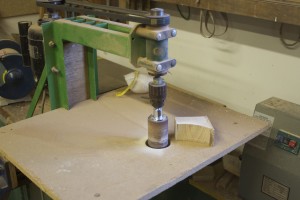
I then traced the outlines on to the plane blank and elaborated a few extra curves to get it to the top of the ramp. Next step was to take to it with the drill press after marking out the exact location and size of the holes that would form the curves that are too tight to navigate with the bandsaw.

IMG_7367IMG_7366IMG_7373IMG_7375


The central hole was removed with a jigsaw …

IMG_7378IMG_7380IMG_7379


… and the rest with the bandsaw. At this stage I took quite a bit of time to come up with a idea and method to shape the sides to fit in with the handle design.

IMG_7383IMG_7384IMG_7385IMG_7387IMG_7388


In the end I came up with this idea. I traced the outlines of the centre piece on to one of the sides, drew a type of halo following the handle lines in some parts and taking it’s own route in others. I removed the waste with the bandsaw and then used it as a template to trace it onto the other side.

IMG_7389IMG_7390IMG_7391


In the pictures below you can get an initial idea of what I was aiming for.

IMG_7392IMG_7393IMG_7394


The arduous task of rounding and smoothing out the rough sawn curves were completed using hand tools predominantly.

IMG_7395IMG_7396IMG_7397IMG_7398IMG_7399


I marked out guiding lines with a pencil using my fingers as a fence. The idea was to cut these before glueing the plane together as it would be difficult to access the area next to the handle once glued. I used a small Lie-Nielsen block plane to cut the chamfers.

IMG_7400IMG_7401IMG_7403IMG_7404IMG_7405


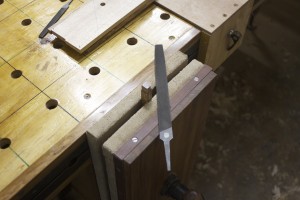
The rest of the curves were smoothed out with a variety of files.

IMG_7408IMG_7409


Once all of this was done I used my Bandsaw Mitre-sled to cut the ramp. You can find an entire post on how I have built the sled on this website.

IMG_7410IMG_7411IMG_7412


The curve cut into the toe section was designed that way to allow more space for the accumulation of heavy shavings as this is a scrub plane that does not require a tight mouth.

IMG_7413IMG_7414IMG_7415IMG_7416IMG_7417IMG_7418


I used the off-cut wedge to support the ysterhout fibers of the ramp in order to prevent blowout, as you can see below. I then planed it flat and square with a freshly sharpened Lie-Nielsen no. 4½ Smoother. The result is clear from the pictures.

IMG_7420IMG_7421IMG_7422IMG_7423IMG_7424


To ensure it is absolutely perfect I used the setup with two different grids of 3M adhesive-backed sandpaper on float glass. It is worth while to take a bit of time to get this surface perfect as it is the most important part of the whole project in terms of the functionality of the plane. If it is off by a few thousands of an inch, the blade is likely to chatter with a vengeance.

IMG_7425IMG_7426IMG_7427IMG_7428IMG_7429


In these pictures you can see the setup I use to mark out the positions of the toe and heel sections relative to each other and the sides. As this is a scrub plane that will eventually have a fairly wide throat. I positioned the heel section, marked it’s position, clamped it in place, got the blade in position, slid it down all the way to the guide, slid the toe section to gently touch it and marked it in that position. The throat will be opened up further at a later stage.

IMG_7430IMG_7431IMG_7432IMG_7433IMG_7434


As I explained in my post on the Petite Wooden Smoothing Plane, I use dimensions/measurements from an article entitled “Wood planes made easy” by David Finck in Fine Woodworking Magazine to mark out the location of the cross-pin. Once you have drilled one, you can get the other into the exact place by clamping the plane together and using the first hole as a guide to drill the second on a drill press. Also note the small panel pins I use to ensure that I can fit the plane back to exactly the same alignment after drilling the second cross-pin hole and the compulsory dry fit.

IMG_7435IMG_7436IMG_7438IMG_7439IMG_7437IMG_7441IMG_7441


From this scrub plane I used my Lie-Nielsen carcass saw to cut the cross-pin made of Assegaai for it’s renowned elasticity, flexibility and stability. I rounded the ends with a file.

IMG_7443IMG_7444IMG_7445


The compulsory dry fit.

IMG_7446IMG_7447IMG_7451IMG_7450IMG_7449IMG_7448IMG_7452IMG_7453


The glue-up.

IMG_7454IMG_7455IMG_7456IMG_7457IMG_7461IMG_7462IMG_7463IMG_7464


Fresh out of the clamps, with quite a bit of finishing left to do.

IMG_7471IMG_7472IMG_7473


I used my Lie-Nielsen no. 4½ Smoother (not pictured) to flatten the sole initially. The final flattening would take place once the cap iron/chip-breaker combination is made and holding the blade tight against the ramp.

IMG_7474


I found this piece of scrap angle iron with which I planed to make the cap iron/chip breaker combination. The stainless steel thumb screw was also a discovery amongst all my carefully hoarded jewels (which is frequently being referred to as junk by others).

IMG_7501IMG_7502


To start with I epoxied a short piece of stainless steel threaded rod to the thumbscrew, because I do not know how to weld stainless steel.

IMG_7517


I then attacked the steel with my grinder.

IMG_7518IMG_7519IMG_7520


It took more than an hour of elbow grease to cut the 45° bevel using the grinder and various grids of wet-and-dry sandpaper on glass together with a honing guide.

IMG_7521IMG_7522IMG_7525


The slight indentation you see is where the cross-pin would get into contact with the iron cap. In the pictures below you can see the hole for the thumbscrew being drilled and tapped.

IMG_7526IMG_7527IMG_7528IMG_7529IMG_7530IMG_7531


The final touches were done on a 1000 grid Ohishi waterstone using the so called “ruler trick” made famous by David Charlesworth. This is to ensure that the back of the cap iron/chip breaker combination sits absolutely flat on the blade.

IMG_7532


As this is a scrub plane I opened up the throat/mouth generously.

IMG_7536IMG_7537


In these pictures you can see how once again I drew the guiding lines for shaping the nose of the plane on the sole to prevent blowout of the ysterhout fibers when chewing the waste away with the bandsaw.

IMG_7543IMG_7544


Prior to cutting away the above curve I drilled out an area as shown using a Forstner bit. This is a unique (as far as I am aware as I have not see any other planes looking like this during my extensive internet research) design feature aimed at getting the best of both worlds in terms of having the big flat area at the front of the plane to press down and hold, yet have a nice grip to lift the plane during the back stroke. I find that with a longer and therefore heavier plane like this it is definitely a bonus to be able to curl your fingers into the nicely rounded slot. An added benefit as you will see later is that it adds some je ne sais quoi to the appearance of the plane.

IMG_7545IMG_7546IMG_7547IMG_7548IMG_7549

Here you can see what I was aiming for.

IMG_7550IMG_7551

I then extended the chamfer of the top edge of the sides to joint up round the actual nose of the plane using a file.

IMG_7552IMG_7553

After some TLC it is starting to look quite sexy.

IMG_7556IMG_7557

Here are heaps of photos from umpteen different angles with the cap iron/chip breaker and thumb screw in place.

IMG_7559IMG_7560IMG_7561IMG_7558IMG_7581IMG_7582IMG_7583IMG_7586IMG_7587


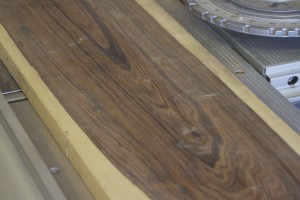
Finally, (just to show off) a few photos posing on a beautiful Rhodesian Teak log.

IMG_7603IMG_7605IMG_7600


4/9/2013 – In the picture below you can see it with it’s Fore Plane cousin at the Finishing Spa.

IMG_7930


Another step closer to finished. Now it only needs a coat of liquid wax tomorrow night.


IMG_7928


14/7/2014

I finally got round to cover the steel parts (lever and lever screw) with wood. I used a small piece of Kaapse Swarthout that fell off when I turned something else for the lever screw and Tamboti for the lever. Both bits of wood were epoxied to the steel.

IMG_1664IMG_1666IMG_1667

I really think it adds some je ne sais quoi to my favourite shop made plane’s appearance.

IMG_1713IMG_1714IMG_1715IMG_1716IMG_1717IMG_1718

Petite Wooden Smoothing Plane


I have been reading about and planing to make my own wooden planes for about a year now. I first thought of the idea when I realised how expensive it is to order good quality planes from the USA. For every two Lie-Nielsen planes I pay for an extra one in shipment fees. Make no mistake, the people at Lie-Nielsen have the best customer service I have ever come across and as everyone knows their planes are superb. Yet, sending it half way around the globe costs money.

The more I read about the wooden versions, the more it sounded like they might almost be better than their heftier cousins. Being a bit of a traditionalist, the idea of building my own wooden planes started to gain some momentum. I then had discussions with Deneb Puchalski of Lie-Nielsen around which blades might be best for the types of planes I wanted to build. He was very helpful and in the end I decided on:

1) Three x 2″ wide standard blades with chipbreakers (25 degree primary bevel)


2) One 1¾” wide standard blade with chipbreakers (25 degree primary bevel)


3) One Scrub plane replacement blade 1½” x 3/16 (thick)


4) One large shoulder plane replacement blade 1¼” x 8¼” x 0.140″ (thick)
The blades arrived on the 11th of June 2013 at which time I started to hunt down beech. Surprisingly, I found some in the Land of the Brave. I decided to first build a smoother and a scrub plane to warmup.
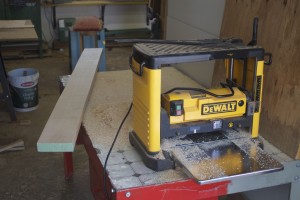
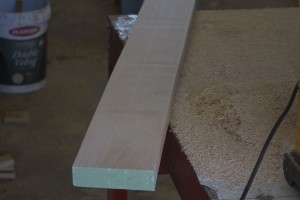
In the pictures below you can see the first chunk of beech after it received attention from the planer.
IMG_6906IMG_6907

At this point in time I still did not rehabilitate my bandsaw (thus not able to re-saw at all and definitely not ysterhout in any dimension approaching what was needed), so I had to plane a fairly small piece of ysterhout down to about 8 mm thickness (from about 24 mm). I wanted to use this incredibly hard wood for the soles of my planes. In the pictures below you can see how I used the bandsaw to cut the sole of the smoother.
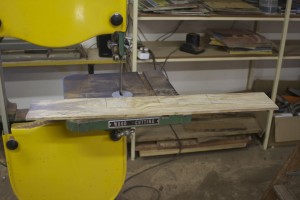
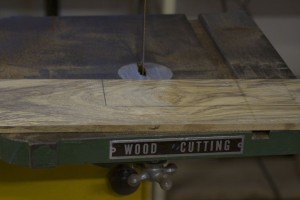
IMG_6932IMG_6933

After studying the grain of the beech I decided to laminate it as you can see in the pictures below. It is impossible to find beech in bigger dimensions (around these parts) so lamination was my only option. Speeaking of which, I can really recommend the documents on building wooden planes written by Larry Williams and his partner at Old Street Tools. You will find the link on the library page of this site. There are articles on grain orientation, best woods to use etc etc.
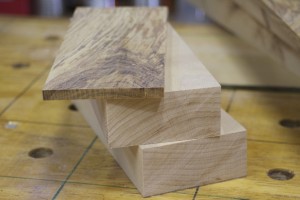
IMG_6935

Here you can see how I laminated the parts.

IMG_6937IMG_6938IMG_6939IMG_6940

For some or other reason I decided to stick it in the face vise, which is not the best as the two jaws are not completely parallel, and I have made this mistake before. Anyway, it came out OK, but I really need to stop doing this.
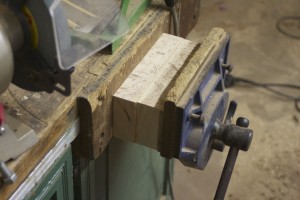
IMG_6943IMG_6944

Next step was to hand plane the sides dead flat and square to the sole. You can appreciate the beautiful soft shavings generated by my newly rehabilitated Stanley no.5 Jack Plane. I wrote a complete post on this project which you can find in the category by the name of “Rehabilitation of old tools”.

IMG_7010IMG_7007IMG_7012

In order to make the next cut I was forced to spend most of the next week trying to fix and tuneup my old crappy bandsaw. The results however made it well worth my while. After the tune-up it sliced such perfect strips off the side that it only took a few strokes with the plane to get them as smooth as a baby’s bottom …

IMG_7031IMG_7024IMG_7032

… as you can see here.

IMG_7133IMG_7134IMG_7135IMG_7136

I then used the planer/thicknesser to get the inside close to the correct width. Maybe a bit less than 3 mm wider than the width of the blade. For this Petite Smoother I chose the 1¾” blade.
IMG_7142


Here you can see how I marked out the bedding angle at 51º (just to be different of course).

IMG_7144IMG_7145

In order to make this next cut I had to build a jig for my bandsaw. I call it a “Bandsaw Mitre-sled”. You can find and read an entire post on this project under the above name …
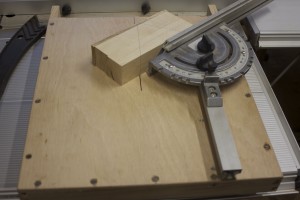
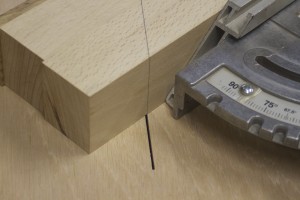
IMG_7146IMG_7147IMG_7148IMG_7149

… here you can see the actual cut.
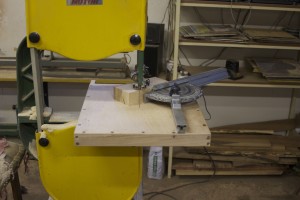
IMG_7150IMG_7151IMG_7152IMG_7153

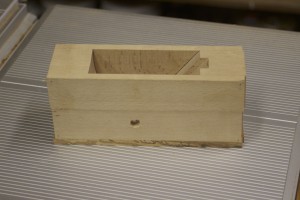
In the first picture you can see the toe and heel section after the first cut. In the next pictures you can appreciate the curve that was cut in the toe section.
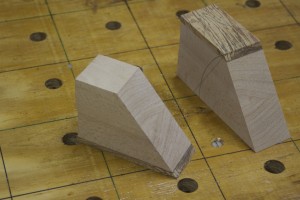
IMG_7154IMG_7156IMG_7157

I used the Green Monster to smooth the curved surface of the toe section.
IMG_7158IMG_7159

In order to prevent blowout of the Ysterhout sole while planing the so called ramp, I used the wedge (off-cut) that was created by the two cuts made earlier. You can see how I clamped it in the legvise to support the fibers on the delicate edge of the sole.

IMG_7167IMG_7168IMG_7169IMG_7170IMG_7169IMG_7171


After getting rid of the saw marks left by the bandsaw by means of the old Stanley Jack Plane I used the 3M Adhesive-backed sandpaper on a sheet of float glass to get it 100% flat. You will note the technique I use frequently in scribbling on the area with a 2B pencil before sanding to identify the areas that needs more attention. Once all the pencil marks disappear you know the job is done.
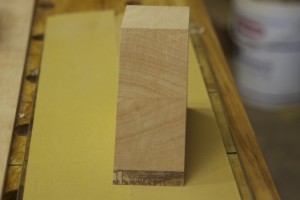
IMG_7172IMG_7173IMG_7174IMG_7175IMG_7177


The next step is to start marking out the position of the toe and heel sections relative to each other. I started by marking out the position of the toe piece and clamping it into this position.
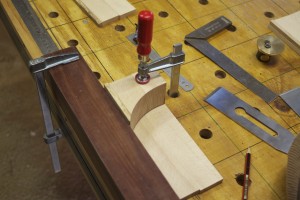
IMG_7181IMG_7182


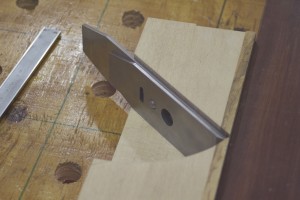
For the next step it is useful to have the blade in it’s position on the heel section, also known as the ramp. In the second picture you might just be able to see the line I marked at 1.5 mm parallel to the sole on the toe section. The idea is to line the cutting edge of the blade up with this line as demonstrated in the second picture. This tells you were the heel section should be relative to the toe section. You then remove the blade and mark the position with a pencil.
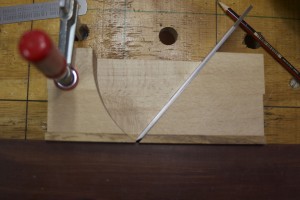
IMG_7183IMG_7184


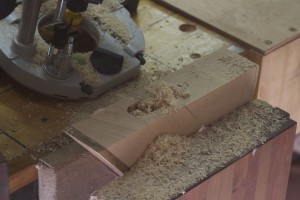
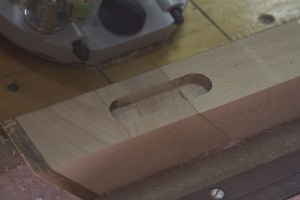
In the first two pictures below you can see where I marked out the perimeters of the cap-screw slot. The off-cut wedge is again priceless to create a big enough surface in order to cut the slot with a router as shown. Please note the makeshift stop I’ve setup on the left hand side.
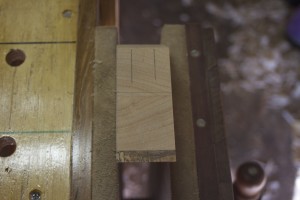
IMG_7185IMG_7186IMG_7187IMG_7188IMG_7189IMG_7190IMG_7191IMG_7192IMG_7193


Just a quick test to see whether the slot functions as planed.

IMG_7196IMG_7197IMG_7198


In order to drill the second of the cross-pin holes you need to clamp the whole shebang together after drilling the one side in the correct spot. You will find a host of different ways to identify this point on the internet. I used the measurements provided in an article titled “Wood Planes made easy” by David Finck in Fine Woodworking Magazine. Once I clamped it all into position I tapped some minute panel pins into each corner to ensure that I could put it all back together exactly in the same way during the glueing phase.

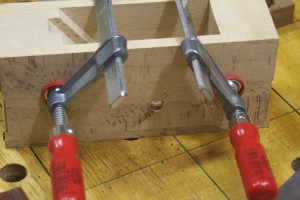
IMG_7199IMG_7200IMG_7207IMG_7210IMG_7208IMG_7212IMG_7215


The idea is then to stick the drill bit through the existing hole to drill the opposing hole exactly in the correct place using a perfectly square drill press setup as shown.
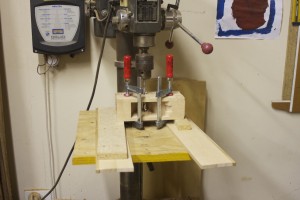
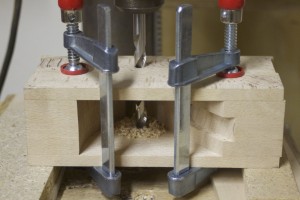
IMG_7204IMG_7206


The cross-pin was created by milling a scrap piece of Assegaai down to a ½” square strip that was much longer than needed. In the pictures you can see how I removed some stock by means of the table saw to start shaping the pins on either side. In future I would rather do this with my Lie-Nielsen carcass saw. In the next few picture you can see how I shaped the pins with a file.

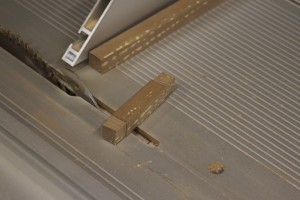
IMG_7202IMG_7203IMG_7216IMG_7217IMG_7220IMG_7221IMG_7222IMG_7223


To make sure that everything fitted perfectly I did a dry fit as shown.

IMG_7224IMG_7225IMG_7226IMG_7228

Then I shaped the cross-pin further by using this setup.
IMG_7230

The glue-up is fairly straightforward due to the panel pins that ensures that it all comes together precisely how it was previously decided. Please note the caul clamped to the sole area to ensure that it ends up perfectly aligned.
IMG_7231IMG_7232IMG_7234IMG_7236

The cross-pins were then trimmed flush.
IMG_7273IMG_7274

Next step was to shape the plane and I started by cutting the ends containing the panel pins away.
IMG_7275IMG_7277

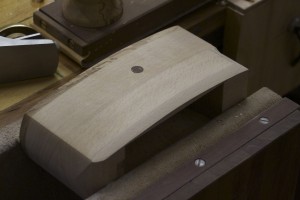
Then I marked out this funky curvy configuration on the ysterhout sole. The reason for doing this on the sole was that I wanted to have the sole at the top while cutting the curves on the bandsaw to prevent blowout of the rocklike yet brittle ysterhout. In the second picture you can see the result of the bandsaw’s caress.
IMG_7278IMG_7279

The bandsaw marks were removed by a series of steps including the use of a float, a smoothing plane and finally various grids of sandpaper on float glass. The result was staggeringly beautiful to say the least.
IMG_7280IMG_7282IMG_7284IMG_7285

The piece of Tamboti you see in the pictures below is the only one I have left and a board I know as long as I can remember. I thought that this was the ideal place to use such a priceless piece of timber. I decided to produce the wedge of this sexy petite plane using Tamboti.

IMG_7316IMG_7317

Here you can see the wedge in it’s early stages.

IMG_7318IMG_7319

The next step was to decorate the plane further with some sexy stopped chamfers. I marked it out by hand using a pencil and my finger as a fence. You can probably see that I deliberately did not do a 45º chamfer, but rather one that further complements the elegant elongated shape of the plane.
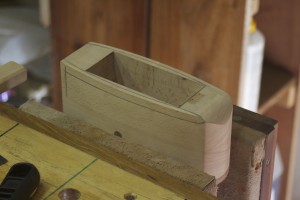
IMG_7320IMG_7321IMG_7322IMG_7323

Using the pencil lines as guides I used a small Lie-Nielsen block plane, a file and my Proletarian Sanding Contrivance to create the chamfers.
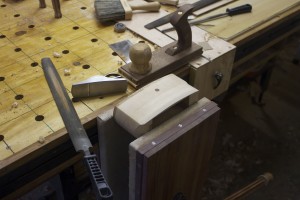
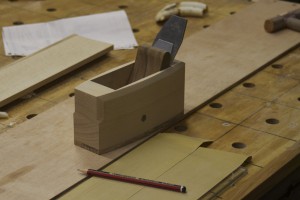
IMG_7324IMG_7325IMG_7326

Then I moved on to flattening the sole. It is important to tap the wedge into position at about the same tension as it would be while being used, before attempting to flatten the sole. The pressure from the wedge deforms the sole ever so slightly so the idea is to flatten it in the shape it will assume while the wedge is tapped into place. You can see that I once again scribbled on the sole prior to flattening in order to identify when it is completely flat.

IMG_7329IMG_7330IMG_7331IMG_7332IMG_7336

In order to custom-fit the wedge I dialed in the width by planing down the sides with my rehabilitated old Stanley no.4 Smoother. Apparently one should be careful not to make the wedge too tight-fitting as far as the wedge goes as it can damage the plane if it expands during humid months. I therefore made it about 3 mm narrower than the ramp. In the last of these three pictures you can see the plane hammer I built to set the plane. You will find an entire post devoted to this project under the category “Handtools”.

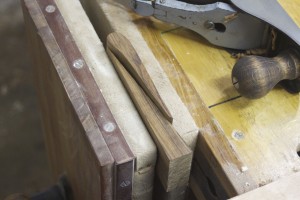
IMG_7333IMG_7334IMG_7335

I sharpened the Lie-Nielsen blade to have a cambered edge.
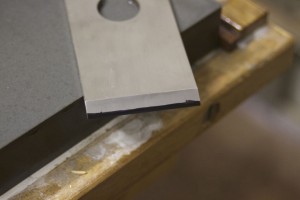
IMG_7337

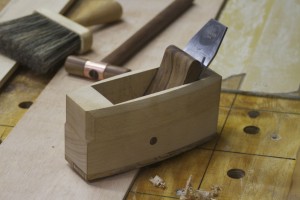
I took to a small piece of swarthout to test the little beauty and the results were incredible. It gave the best finish I have ever seen and the shavings were extremely thin and soft. There were not even a hint of chatter. What also surprised me was how easy it is to set the blade with the small plane hammer. It almost felt easier than setting a cast iron plane.

IMG_7338IMG_7339IMG_7340IMG_7341IMG_7353IMG_7351IMG_7349

Here are two photos to show off the beautiful Lie-Nielsen iron-chipbreaker set.
IMG_7344IMG_7343

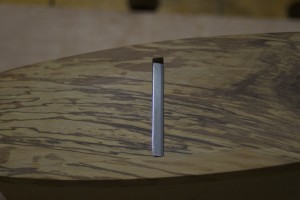
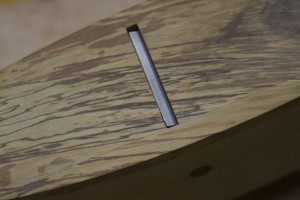
Part of the success of this little plane must be the tight mouth. In these pictures you can also appreciate the je ne sais quoi of the ysterhout sole.
IMG_7345IMG_7346IMG_7347

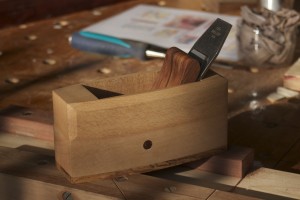
Finally a few pictures of the plane in the late afternoon sun after a light coat of Ballistol. I plan to treat the sole with wax once I find a suitable product.
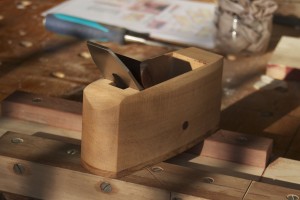
IMG_7465IMG_7469IMG_7466IMG_7467IMG_7468


4/9/2013 – I finally got round to treating this little beauty after using it for a few weeks. You can see how it joined it’s bigger cousin at the Finishing Spa.
IMG_7916IMG_7917IMG_7920


Here are a few final photos of a little plane that has already become a go-to tool in my shop within the space a month.
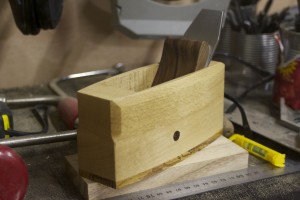
 

IMG_7931IMG_7933IMG_7934IMG_7923IMG_7924

Plane Hammer

In this post we will briefly return to a state of “Mallet Mania”. As you might remember I wrote one of my first posts on the first four mallets I made and called it “Mallet Mania”. This past weekend I made the fifth in the form of a specialised plane hammer. It was necessitated by the fact that my first wooden plane was getting close to being finished.

I therefore squeezed in some time dedicated to the hammer necessary to set the blade of my Petite Smoothing Plane (post to follow in the near future). As per usual, even the bits and pieces that are available to use for such tools is quite limited in Namibia. In the pictures below you can see what I started with. It is one of those copper rings that plumbers use to join copper water pipes.

IMG_7238IMG_7248

I chamfered the inside edge of the one side with a medium sized file.

IMG_7245IMG_7246IMG_7247

Then I took a piece of Kershout and Witpeer I laminated for the handle of my legvise, that was left over and turned the head of the hammer (far right) together with three file handles while I was at it. It was turned in such a way that one side was similar in diameter to the outside of the copper ring and the opposite side slightly smaller than the inside diameter tapering up to sightly bigger than that. The idea being that one could tap the ring over to fit tightly.

IMG_7261IMG_7262

Here you can see how far the ring slid over the wood without any force. I applied epoxy to act as a lubricant and adhesive before tapping it into place.

IMG_7265IMG_7266

To ensure that the ring had nowhere to go I cut a thin curve to accept a very slight wedge, which was taped in after applying Gorilla PVA wood glue.

IMG_7269IMG_7288IMG_7271IMG_7272

The sides of this wedge were trimmed flush …

IMG_7287IMG_7290

… and cut to length as shown below.

IMG_7291IMG_7292IMG_7294


The next step was to mark out were to drill the hole for the handle. I used a compass to scribe a circle 2 mm bigger than the hole drilled for the pin of the handle in order to have a reference of how much I should enlarge the hole on this side to accept another wedge.

IMG_7295IMG_7296


In order to drill the hole accurately I made this quick jig out of scrap plywood. The hammer’s head sits steady in the groove and held in place by the drill press vise.

IMG_7297IMG_7298IMG_7299IMG_7300

IMG_7301IMG_7302


I used Kershout for the handle. Below you can see how I shaped the pin.

IMG_7303IMG_7304IMG_7305


Then I used a spoke shave, a rasp and a card scraper to shape the handle. It makes easy work of such a job.

IMG_7311IMG_7312


I then glued a small piece of sealskin to the one striking surface to give the option of a softer blow, when striking the wooden parts of the plane (as opposed to the plane iron).

IMG_7327IMG_7328


The final product prior to the usual Ballistol treatment.

IMG_7313IMG_7314IMG_7315


Reprobate Sealskin Strop

This is a straight forward hand tool that some might argue to have become obsolete, especially since the advent of devilishly fine waterstones used in conjuction with Nagura stones. However, to me it reminds of the days gone by, which creates a sense of being part of the traditions of the craft.

That is why I fashioned this sealskin strop. Before all the whiny greenies get on my back, I did not kill any seals for this purpose. I simply bought the skins at Nakara. As far as I know, Namibia has been involved in a sustained seal genocide to which more liberal societies have developed an aversion of note. As I see it, these seals were well and truly dead by the time I bought the skins, so I might as well honour their expired existence by creating a timeless heirloom tool with it. Come to think of it, in the light of the above I should probably warn sensitive readers that this post might contain disturbing images, if you are that way inclined.

As per usual I found a small piece of Assegaai for the job. The bandsaw was responsible for the rough shaping, before I took to it with a few files to round the areas forming the handle.

IMG_6930IMG_6931

I then used a card scraper to remove the file marks, which I can really recommend. It works like a charm for this purpose, as you can see from the pictures below.

IMG_6989IMG_6990

The area that would end up covered with sealskin, were then planed flat with a rehabilitated old Stanley Jack Plane. I wrote a comprehensive post on this particular endeavor, which you will find under the category of “Rehabilitation of old tools”.

IMG_7091IMG_7092

To make absolutely sure it was flat, I used 3M adhesive-backed sandpaper on glass to get it as close to perfect as possible. I used the technique of scribbling on the wood with a 2B pencil before sanding to identify the low spots. The job is done once all the pencil marks has disappeared as you can see in the last picture. I advise those sensitive types to stop reading at this point.

IMG_7093IMG_7095IMG_7097

Two sealskins as bought from Nakara. In the closeup picture you can appreciate that the leather is quite rough, which is probably wicked for this purpose.

IMG_7098IMG_7099

A magic marker was used to trace out the strips needed.

IMG_7100

I first glued the narrow strips to the sides …

IMG_7101

… then the wider strips.

IMG_7118IMG_7119IMG_7120

I used a very sharp chisel to remove a few untidy strips of leather and …

IMG_7125IMG_7126

… finally the usual treatment with Ballistol gave the Assegaai a beautiful sheen.

IMG_7128IMG_7127

It’s a dowel plate mate

This is another brief post explaining how to make a very handy hand tool in no time. If you are in need of custom made dowels, this is a very useful tool. As usual I got this idea from Lie-Nielsen.

All you need is a scrap piece of steel. I took this chunk of steel left over from another project and drilled 5 holes starting at 10 mm increasing by 0.5 mm at a time up to 12 mm.

100_0553

100_0555


The idea is to cut square strips of wood slightly bigger than needed, shape it a smidgen with a plane …

100_0554100_0556100_0557


… and tap it through the holes, starting with the biggest that would accept the blank and moving down to the size intended. In the pictures below you can see how I made the dowels for my mallet. If you want to know more about the process of building the mallet, see the post titled “Mallet Mania”.

100_0558IMG_5670IMG_5672


… and voilà, some custom Witpeer dowels!!!


100_0559


Shameless Flush Plane knockoff

By now I presume that you are quite familiar with the fact that I have to improvise from time to time, (more often than not) in order to acquire tools that most other people buy at their corner cafe. In this particular case my improvisation included the shameless liberation of a Veritas catalogue idea. They sell a so called Flush Plane, which I thought could be very handy as they explained for:

“flush trimming projections such as glue lines, laminate edges, plugs, etc. It can also be used for cleaning out inside corners (e.g., hinge gains, tenons, half-laps)” As copied from the catalogue of September 2012.

So I set about to make my own version of this elusive (only to mortals from Africa) tool. As usual I used scrap pieces of Assegaai. I promise to use another species of wood once I start making furniture. Despite all the hassle to get hold of tools I did find Stanley plane blades which would fit the 1/2 numbers, not the others only the 1/2s!! Therefore this rip-off was tailored around the mentioned blade.

IMG_6291IMG_6292

In the pictures below you can peruse the first phase of sculpting the laminated Assegaai blank. At least the actual contours of the rip-off are entirely my own ingenuity.

IMG_6293

Enter Phase two.

IMG_6297IMG_6298

Phase three was done with hand tools exclusively. I created an area at the front of the handle where one can get a grip with your leading finger/s. On the sides (less visible in the pictures below) I hollowed out an area where one’s wrap-around fingers can nestle into for improved grip. You can also see how the blade was marked for drilling holes to accept the screws that would ultimately fix it to the bottom for the grip.

IMG_6660IMG_6661

Once the shank holes were drilled I first transferred it to the grip before countersinking the holes in the steel.

IMG_6662IMG_6663

The reason for this was that I had to countersink the holes in the steel to the point were it increased the diameter of the shank holes. It was necessary to ensure that the steel screws seat below the level of the blade.

IMG_6665IMG_6666

After seating the blade the sole of this knockoff was lapped flat with sandpaper on a piece of glass.

IMG_6668

The final product lacked je ne sais quoi, so I decided to play around with some craving options. I will add it to this post once it is done.

IMG_6669IMG_6670IMG_6671IMG_6672

Proletarian sanding contrivances

Although I do own a belt sander and two orbital sanders (that were past down from my Dad to me), I still prefer sanding by hand. Unfortunately the cheap and nasty commercial sanding blocks I used to own in New Zealand were all stolen en route to Namibia. I thought making some sanding planes would be a good start towards my next goal of building some wooden hand planes. This way I get some experience in producing the plane tote (handles) and joining it to the rest of the tool. Even with sanding planes the aim is to keep it as flat as possible, so this way I can get a feel for doing just that.

One of the annoying things about using a sanding block is having to change the paper all the time as you move from one grid to the next. Therefore I decided to build 3 short (230 mm) and three long (380 mm) sanding planes, in order to load each with a different grid. It would allow me to simply grab the next plane when moving up a grid.

I had some trouble to get the pdf documents on Stanley totes (handles) from the Lee Valley website printed to the correct scale. It necessitated me to take the tote off my Lie-Nielsen Low Angle Jack Plane and use it as a template. The Lee Valley documents were very helpful nonetheless as it explains clearly what the best sequins of steps are to produce the handle. In the picture below, you can see how the Lie-Nielsen tote was used as a template, ensuring that the hole running through the tote is 90 degrees to the sides of the board.

DSC03197

Here you can see the documents, as mentioned. It is downloadable from the Lee Valley website.

DSC03198

Below you will notice that the hole that runs through the handles were drilled before drilling the large diameter holes which simplifies the actual cutting of the blanks.

IMG_6676IMG_6675

DSC03199DSC03200

Next step is to shape the blanks to resemble the perfect Lie-Nielsen tote it is based on. For this purpose I used the green monster, which is a machine my father built many years ago. In the pictures below I took it’s work surface off to enable me to maneuver the blank a bit more. Some of the shaping was done with the surface intact.

IMG_6677IMG_6678IMG_6679IMG_6680IMG_6240

Next I took some scrap Witels, which I thought would be a nice colour match with the pale fungi induced spots on the Assegaai handles and plane bodies. Yes, I know, ‘a certain je ne sais quoi’. After laminating the three pieces I turned the six knobs from it

IMG_6255IMG_6257IMG_6259IMG_6260IMG_6261

Unfortunately I did not take pictures of how I prepared the plane bodies. It was fairly gnarled bits of Assegaai to start off with. In order to flatten these bits of wood I spent quite some time working on my hand planing technique. Then I moved on to custom fitting each handle recessed about 4mm into the plane body. The totes and knobs were then glued and screwed into it’s permanent home for the next 500 years (I hope).

IMG_6271IMG_6272IMG_6773IMG_6772IMG_6273IMG_6275IMG_6289

The mechanism I chose to fix the sand paper to the plane necessitated a lot of fiddling with small bits of wood, screws and panel pins. Although probably not the fastest way of changing paper, it works like a charm and also adds a certain je ne sais quoi on the looks side of things!

IMG_6688IMG_6686IMG_6685IMG_6684IMG_6683

Seeing that these are sanding planes with which I do not want to spoil a surface that was already elbow-greased to perfection by hand planing, the next critical step was to ensure that they are as flat as glass. I used two different grids of 3M Adhesive-Backed Sandpaper on a piece of glass. You can see how I used the trick I learnt from David Charlesworth by scribbling on the sole with a pencil to see low spots. I saw him using this in a DVD on sharpening. I think if I saw this guy working in his meticulously cerebral fashion earlier in my life, I probably would have pursued woodworking as a career. His DVD’s are highly recommended. I bought mine from Lie-Nielsen.

IMG_6278IMG_6281IMG_6282IMG_6284IMG_6285

Next I mixed epoxy and added some wood dust to increase the viscosity. This concoction was then used to fill the holes left by the countersunk steel screws which fixed the knobs and handles to the plane body. It dried to an incredibly hard filler, which was again sanded perfectly flush with the rest of the sole.

IMG_6776IMG_6777IMG_6286IMG_6287

I then glued Red Dear leather (short planes) and Kudu leather (long planes) to the soles to ensure an even contact between the sandpaper and wood that is being sanded. You can see how in one case I used a piece of glass as a flat surface clamping through the assembly table. In the other case I used the two sanding planes as each other’s flat reference surface, to ensure flat and consistent adhesion of the leather.

IMG_6893IMG_6894IMG_6895IMG_6896IMG_6294IMG_6295IMG_6897IMG_6898IMG_6689IMG_6922

Finally the first test with sandpaper and it works like a dream.

IMG_6299IMG_6300

Usually my favourite part of building these tools is to rub on Ballistol. It brings out the beautiful colours of the wood and does not dry to a film at all, nor does it go yellow over time.

IMG_6302IMG_6681IMG_6682


Here you can see how I indicated on the back of each plane which grid of sandpaper it is loaded with. This makes it easy to simply grab the next plane needed during a sanding operation.


IMG_6924IMG_6923


In these final pictures you can see where the planes found their little home.


IMG_6927IMG_6928