All posts by Gerhard Marx

Psychiatrist and Woodworker

Mystery Tyzack? … yeah right!

2/6/2016

This is a post that I almost forgot about, but since chatting to the famous Bob’s your Uncle Demers (aka The Valley Woodworker) recently it reminded me of the information he found on this saw. As you might remember, this Tyzack was part of my December 2015 tool finds in the Garden route. I asked for help to get an idea of the saw’s history.

IMG_5782IMG_5785IMG_5783IMG_5784

I received the below information from Bob Demers on the 10th of March 2016:

In 1839, 30-year-old sawmaker Henry Tyzack moved from Sheffield to Shoreditch, just outside the City of London. Henry’s father Samuel was a sawmaker, as was his younger brother Joseph and his uncle, Thomas Tyzack. We do not know exactly when Henry started making saws and other tools under his own name, but 1843 is the date used by the successor firms. In 1861 or shortly afterwards, Henry transferred the business (with two employees) to his eldest son, Samuel, who in 1860 had leased a small shop of his own. By 1871 Samuel had five employees. Henry died in 1876 and Samuel died in 1903.
The “& Son” in the name S. Tyzack & Son likely refers to Edgar, born in 1877, although another son, Horace, was also involved in the business. The name changed to S. Tyzack & Sons in 1905, after Edgar Tyzack inherited the business.
Throughout its history, the Tyzack firm resold tools made by others and also sold tools that they made themselves. Their product line primarily consisted of hand tools for the carpentry and cabinetmaking trades. This website’s focus is machinery, and this firm is listed here because they made miter trimmers (which straddle the fuzzy line between tools and machines) and, from 1920 to 1959, metal-turning lathes. These lathes, and some of their miter trimmers and related products, used the “ZYTO” brand name.
The company operated until 1987 when it was finally wound down.
http://www.tyzack.net/hackney.htm Early history of the firm

So your back saw is from BEFORE 1905 (when the name changed to Tyzack & Sons)
and AFTER 1860 when he transferred his business to his eldest son.
So between 1861 and 1905.
6th Jan 1871 a city ordnance renumber No 8 old street to No 345
So your saw was made between 1871-1905

In all respect it is a good saw

Cheers

Bob

Clearly there is no mystery in the antique hand tool world too big for Bob to solve.

My second commission – part 5

23/5/2016

These Witpeer (Apodytes dimidiata) boards had a good 5 weeks to settle after all that hand milling we (yes “we”, we are a team now, I do the work and you get to read about it in the comfort of your own shop/home) did in the first part of April. They were clamped to each other to prevent even a thought of warping. It has therefore become time to glue them together to produce the first of three layers of timber that will ultimately become the trapezoid leg of this table.

In the photos below you can hopefully see my usual artwork on the face side. The boards were arranged with much deliberation on where the cracks and interesting areas of colour change should endup. Once that is done I usually draw a so-called carpenter’s triangle (sometimes referred to as a cabinetmaker’s triangle) across all of the boards to ensure that I can easily get them back in this order after planing individual edges.

IMG_6869IMG_6870

I then marked out the location of the dominos I use to line the edges up during glue-up. Dominos are similar to biscuits, just better (as you would expect from Festool). I use the mark illustrated below to indicate where the slots for each domino should go. The ring around the end of the line is there to help distinguish these marks from others. I have found in the past that one can get confused with the lines of the carpenters triangle once the boards gets mixed up.

IMG_6871IMG_6872

Here I am preparing the glue surfaces of the edges that go together. The idea is that you fold each board (on either side of the joint) down and away from you, much like you would do with a book were the cover is facing you and you close the book. Then you clamp them together with the two edges flush at the top. This way your error (if you go ever so slightly out of square) would cancel out for a perfectly flat joint once planed. You also want to create a very slight hollow in the length of these edges, which will result in a so-called spring joint. In other words, during assembly the ends of the joint will meet first and very gentle pressure from your clamps will close up the minute gap in the centre of the joint.

IMG_6881IMG_6882

As a wannabe exclusive hand tool woodworker (AKA a hybrid woodworker) I have to admit that one power tool I really do enjoy using is my Domino. Why? I am not sure. It might be because it is relatively quiet, fairly accurate and very easy to use. Here I am preparing the small (3 mm) slots for the three dominos I decided on for each of these joints. I prepared only three edges and then glued them up one at a time. PVA glue sets so quickly in our dry environment that I simply cannot risk doing more than one at a time.

IMG_6883IMG_6884IMG_6885IMG_6886

The next day the edges of those glued up panels were prepared and glued to each other.

IMG_6887IMG_6888

30/5/2016

The day after that the two bigger panels were then prepared and glued. As you can see it necessitated a different strategy to clamp in my bench(for edge preparation), but the bench came to the party.

IMG_6891IMG_6892IMG_6890

I honestly cannot remember what one calls this thing that I made to stop the leg vise from twisting (when you clamp on only one side of it), but it works like a charm in situations like this.

IMG_6893IMG_6894IMG_6895

For the final glue-up I had to first cut 1″ galvanised pipe to appropriate lengths as all my other clamps were too short. Luckily there were a few left in the stash that came from my father’s shop.

IMG_6896IMG_6897

Didi assisted me to make sure this joint ends up flat as (this is a Kiwi expression for those of you who thinks that it is just poor grammer).

IMG_6900

30/5/2016

Once the whole panel was glued-up, I used a Festool TS55 track saw to cut out the trapezoid shape.

IMG_6909IMG_6917IMG_6918

For the angle of the sides of the trapezoid shape my Stanley no. 18 bevel was simply set to that of the prototype/mockup pictured below.

IMG_6919IMG_6920IMG_6921IMG_6922IMG_6923

The panel was then clamped to straight Kershout (Pterocelastrus tricuspidatus) beams to keep it honest, while I mill and shape the timber for the next layer.

IMG_6939

The second layer will consist of three strips (top, middle and bottom) of Tasmanian Blackwood that will run at 90º to the grain of the first layer. This second layer will ensure that the trapezoid leg cannot cup or bow over the years. It will also be completely invisible once the third layer is installed. The unmilled Tasmanian Blackwood is on the left of the picture leaning against the wall. The third layer will be milled from the Witpeer board to the right of it, lying on the sawhorses.

IMG_6924IMG_6925

The reason why I chose the slightly softer Tasmanian Blackwood for this layer is because it will take a nail better than Witpeer. I plan to nail the third layer to TB layer using brad/finishing nails. You will have to wait a while to see exactly what I mean. Anyway, the Tasmanian Blackwood will be unsighted so it does not matter that it is a different species.

IMG_6926IMG_6927

The two TB boards were ripped on the bandsaw and then received a light planing before being clamped to settle over the next week or so.

IMG_6940

The Witpeer board was ripped using the track saw and stored to acclimatise to the shop’s ambient humidity.

IMG_6941

Hopefully we will be able to deal with the next two layers in part 6. I would love to get that done by the end of June, but if not that is fine too.

African Rosewood Roubo

30/5/2016

I’m sure this must be the millionth Roubo journey that’s been blogged about! Thanking Gerhard again for the opportunity, this time to convey my African Roubo experience to you, here goes yet another one.

Since reading Chris Schwarz’ Popular Woodworking Magazine blog entries on workbenches years ago, I have always wanted to build me a decent solid workbench. Nothing less than a Roubo. I like working with my hands and I’m not scared to strive to acquire new skill sets (still have a hard time with welding and plastering though…). Sure, at that stage I already had a few projects under the belt. Some of you may associate with this, you know, sawing on the stairs with the wife standing on one end, planing on a temporary table in the shop and picking the work piece up from the floor every few minutes because of makeshift bench stops, sanding outside on the lawn etc. And surprisingly these projects came out fine (also despite working with “hobbyist class” tools). Later I got my hands on a workbench that was quite sufficient but it was an ugly, impractical apparition. Partially perhaps because it doubled for the previous owner as a metalworking bench – steel framed, scaffolding plank top with a 16mm plywood sheet screwed onto it. Adding a vise and bench stop eased the pain a great deal.

Simultaneously I developed the need for better quality tools (not that I deserved them). That was when I started visiting antique shops looking for quality, antique bargains. And soon had the unfortunate life changing experience by discovering eBay (and the intimacies of shipping costs).

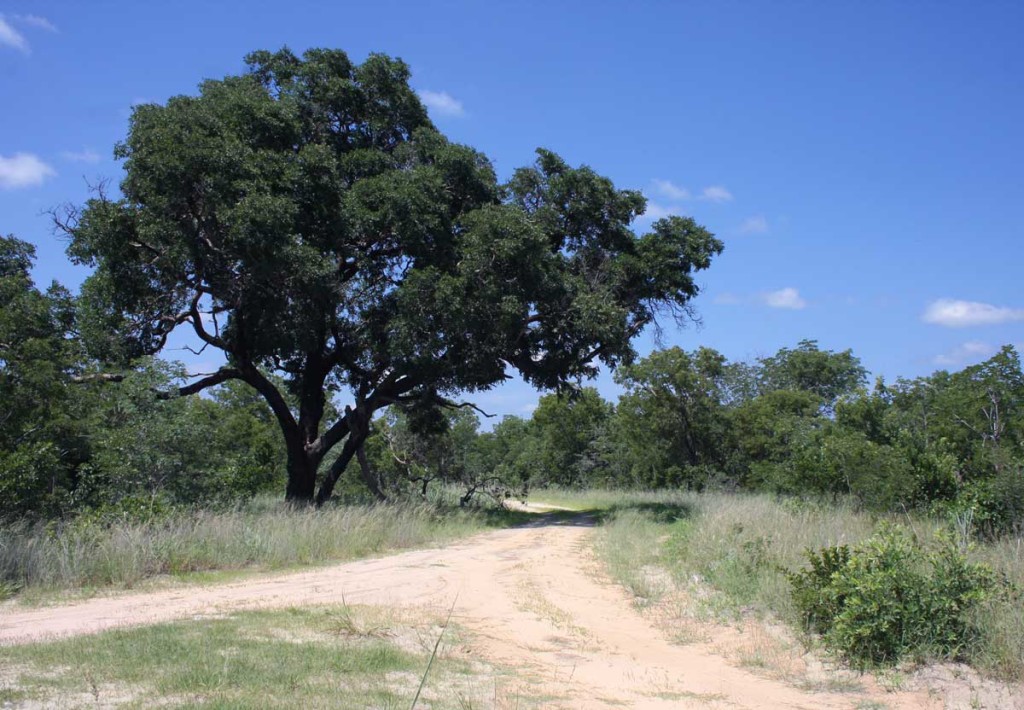
Fast forward to the Roubo. I started to investigate what lumber to use that was available in at least 4″ thickness. Didn’t really feel like following the “laminated pine” route, rather wanted to use solids as opposed to laminated wood. Our Pine is also generally softer than the US version(s), except perhaps for the Cape grown lumber, which has much tighter growth rings than those from up north in Southern Africa (because of less favourable growing conditions, I assume). I considered using railway sleepers and then just plugging all the holes but that could turn messy (and ruin your tools). Oak was available from a local timber agent but prohibitively expensive in such dimensions. Started to contact mills for rough cut lumber (any lumber of sufficient dimensions) and eventually got referred to a company that were importing and then kiln drying lumber from countries up north (Southern Africa). It turned out that they did have four sleeper sized beams that they wanted to get rid of, the reason I can’t remember anymore (not that the reason really mattered to me!). Between 2,4 and 3,2m lengths and 110mm (4½”) thick. It was African Rosewood (Guibourtia Caleosperma), family of Bubinga. Eisch!
Roubo0

For R400 (about US$30) all in all. Kiln dried at no extra cost (the courier down to Cape Town was about R900)!! Ridiculous, I know, a real giveaway!! Although I felt remorse using such beautiful timber for a workbench, I reasoned if I strive to do a real special job, I may eventually pass it down to my son as a heirloom! Furthermore, I have sentimental value to the tree species, since my dad and me used to camp under these species trees on our numerous hunting trips in the far north of Namibia. Winters in Namibia makes for a grey/drab landscape and these trees were the only evergreen trees in the veldt. It is ideal to set up camp under one of these. They call it “Ushivi” up there).

Usually, I can be quite a pain when planning something, because I have another pet hate, and that is to have to do something over, just because I messed up because of a lack of planning or because I was rushed. Perhaps a tiny bit of Kavango-bush mentality (“there is always tomorrow) left after all these years? Therefor I prefer to take my time, investigate something pretty thoroughly and only then commence with my project (which therefor often seems to take forever). And yes, I know I’m boring. I’m also well aware that I’m a jack of many trades but master of none. So, since I’m doing this part-time, there’s no rush? If some chores around the house comes up, it tend to take priority (or gets made my priority…) and my woodwork projects tend to gather dust. So, the bench for this part time wood butcher had to be not too large (I have limited shop space), not too small, dimension ratios acceptable, tenon selection also had to be a special feature without building a bells and whistles thing. And simultaneously optimising usage of my available lumber.

Also decided to build it with hand tools (bit of a traditionalist, but lets not go there yet), so ripping and cutting these beams into manageable pieces was a mountain I had to cross, sooner or later. But by just Googling a few black and white pics of (must be) “desperados” cutting down rather large Redwoods in the early days with hand saws and axes, made me feel much more positive about my intentions! The more the bench took shape in my mind, the more urgent my urge became to start plonking away!

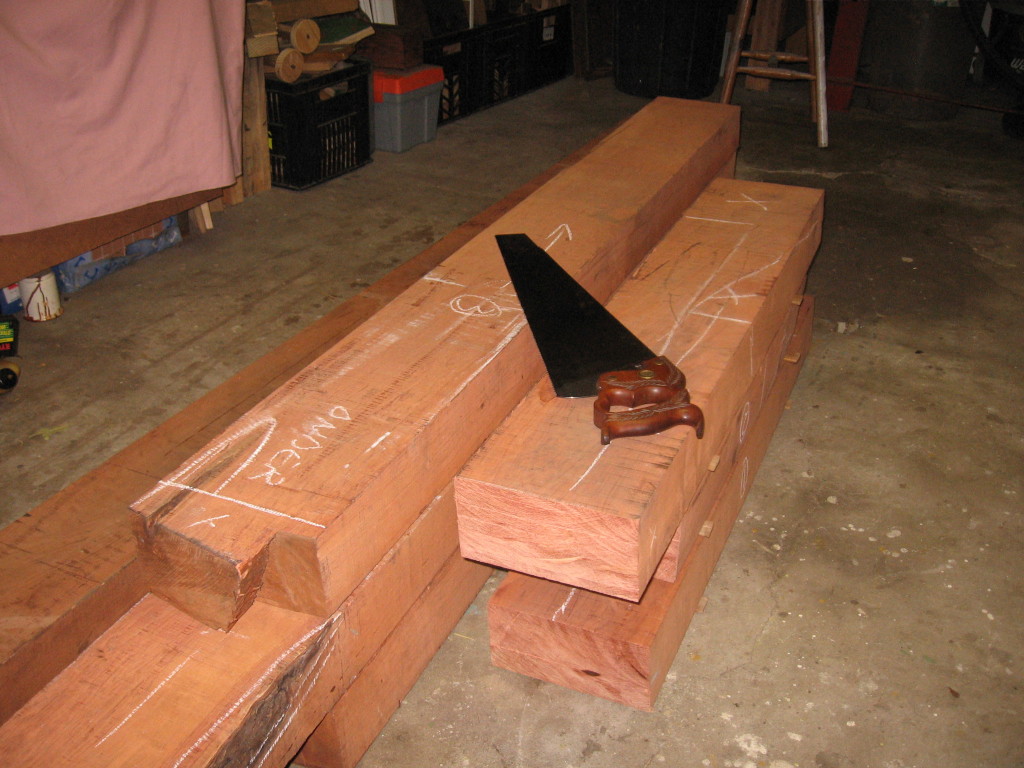
Roubo1 (1)Roubo2

Sure enough, the project slowly started to gather momentum. Dimensioning the legs on my old workbench to 120x100mm (5×4 inches)
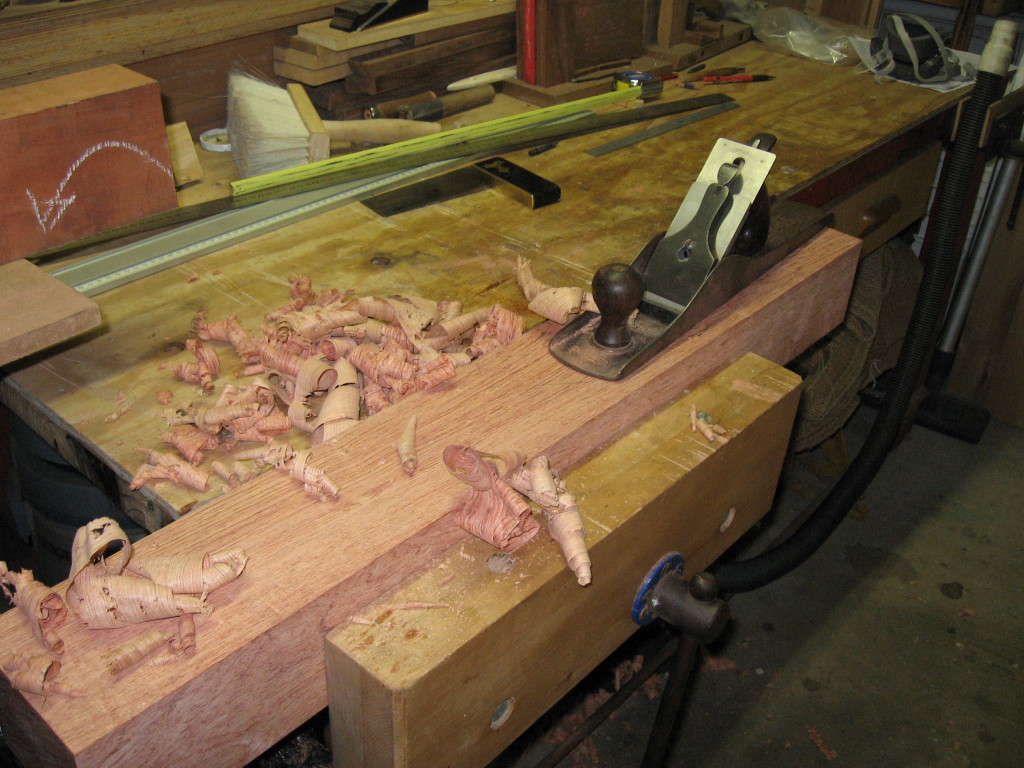
Roubo3 Poot

Dimensioning one of the tree top beams. Note, because of its sheer weight I required no clamps except for an improvised “bench stop”, just in case…
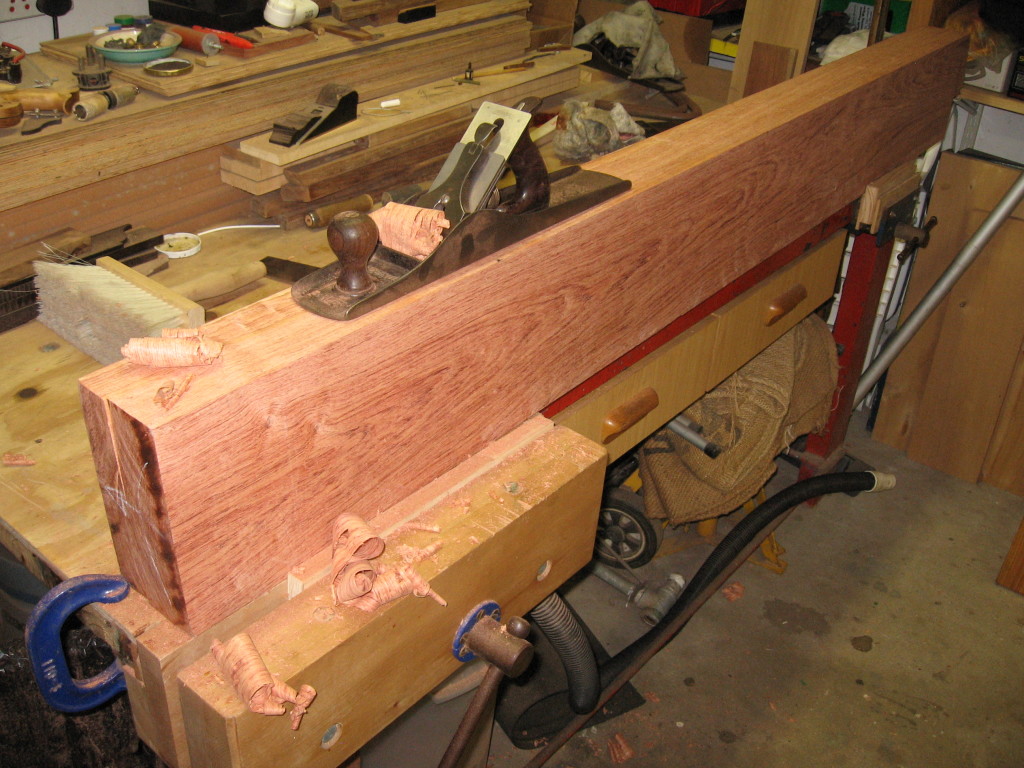
Roubo4 Blad

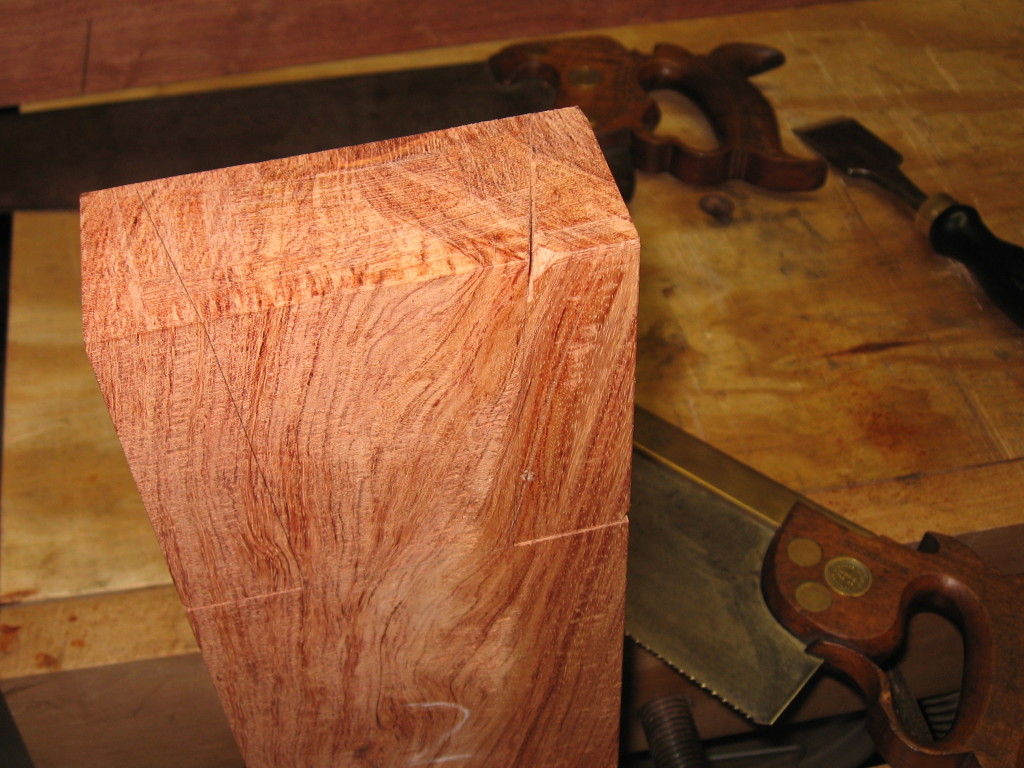
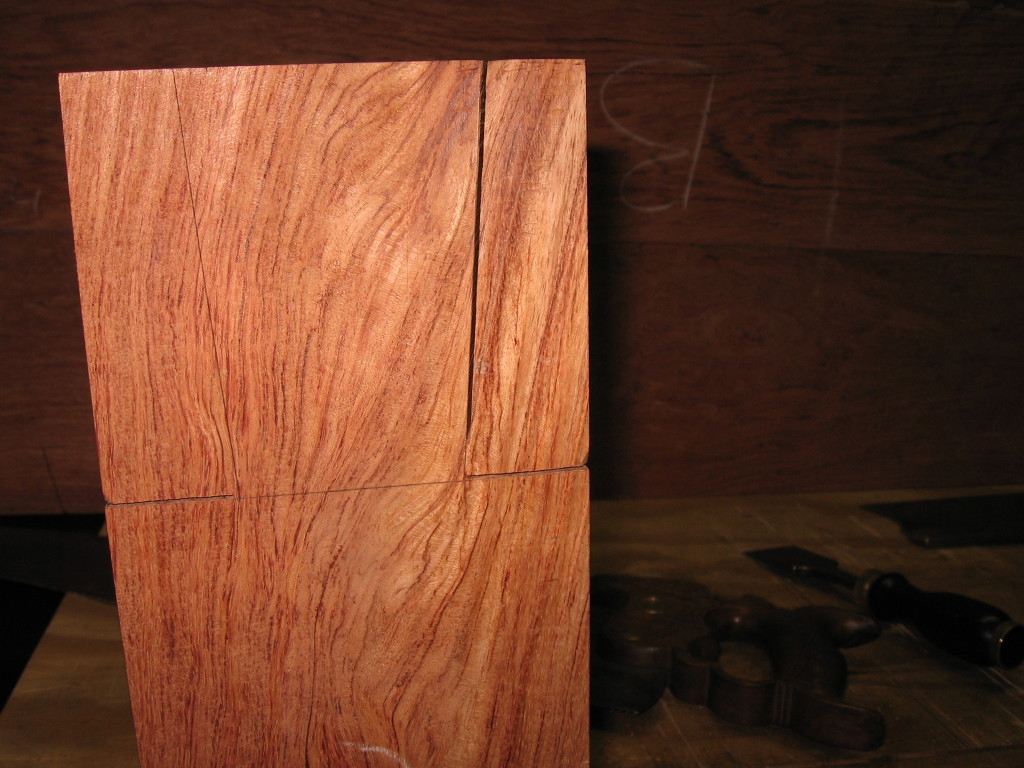
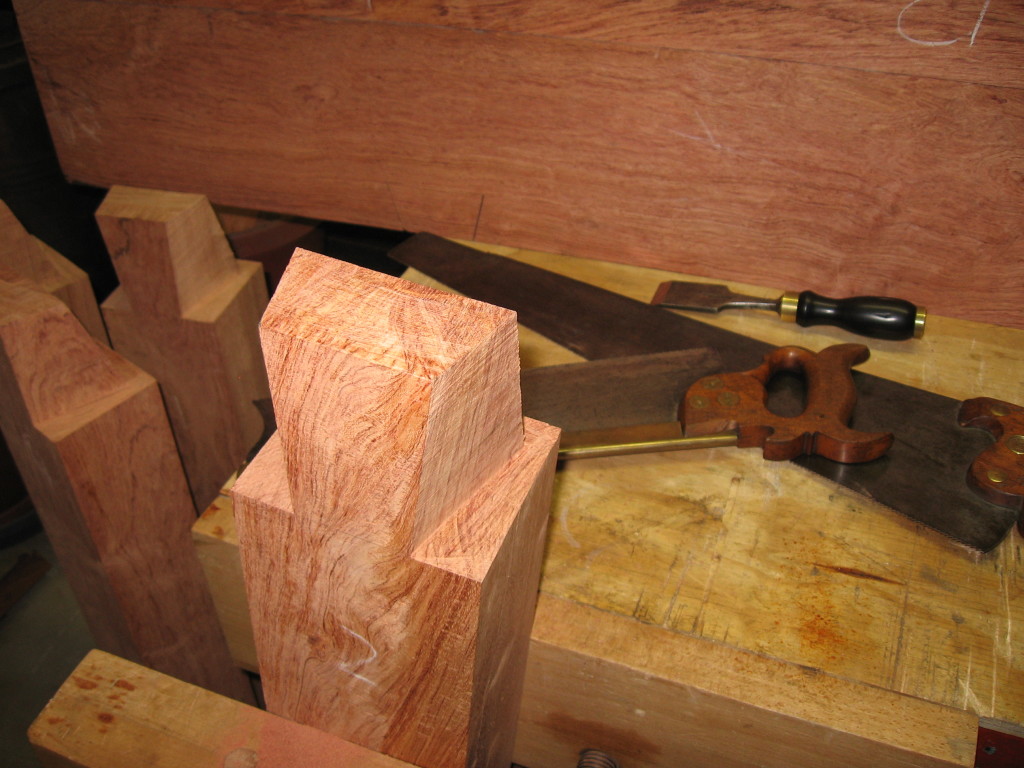
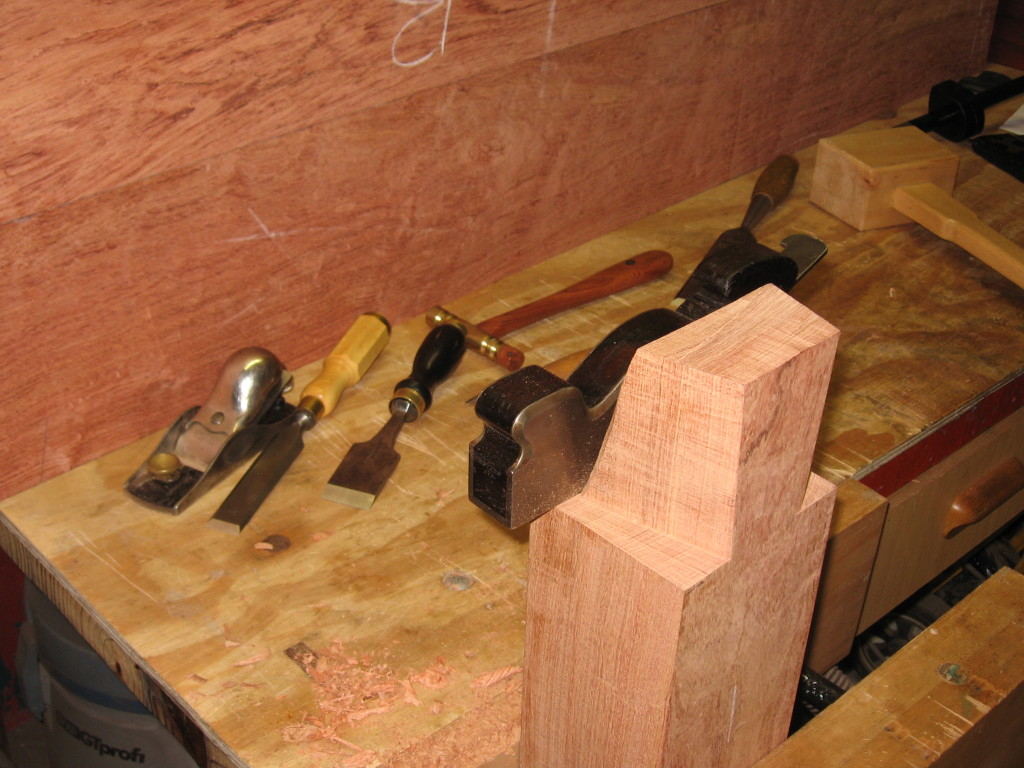
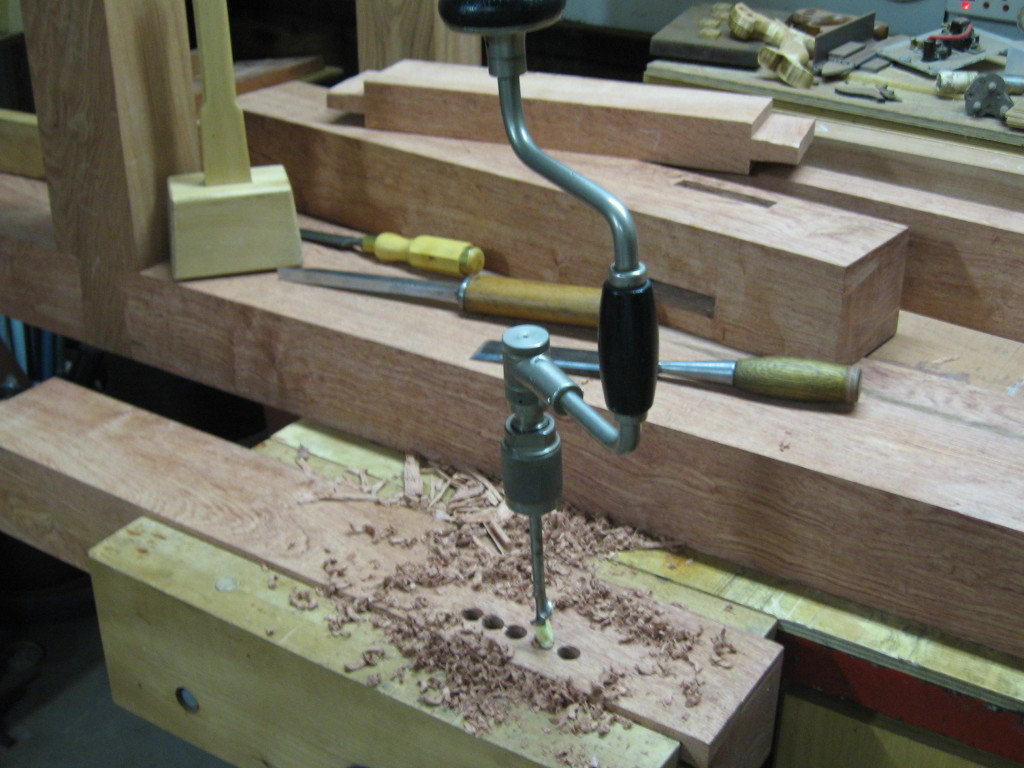
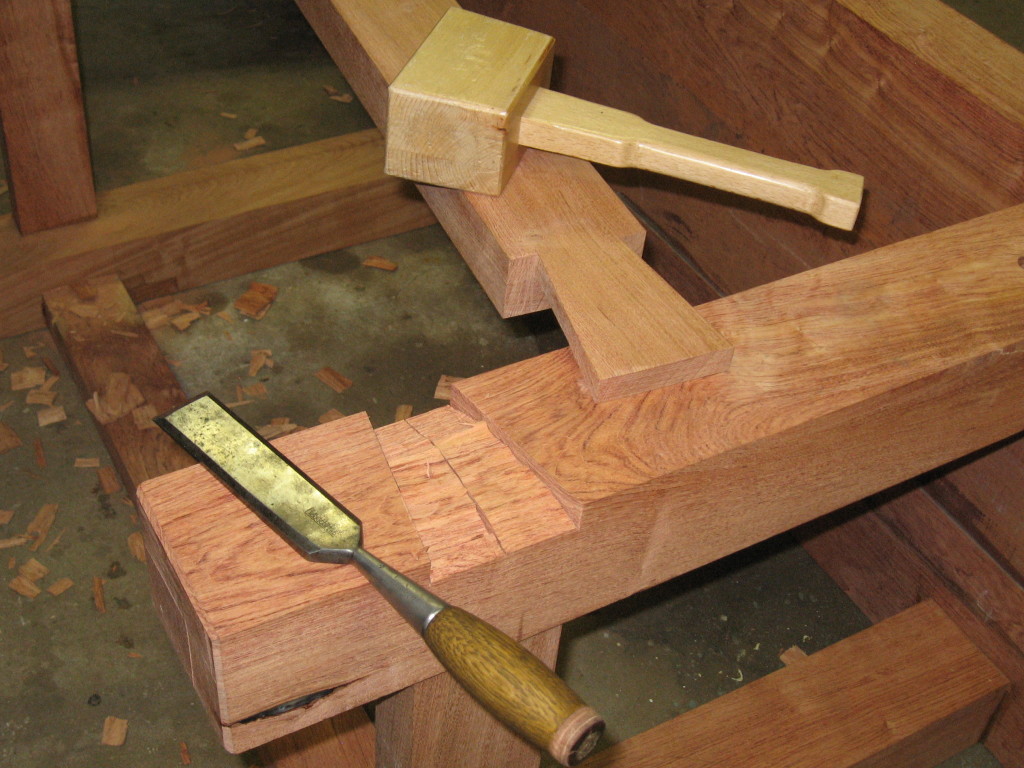
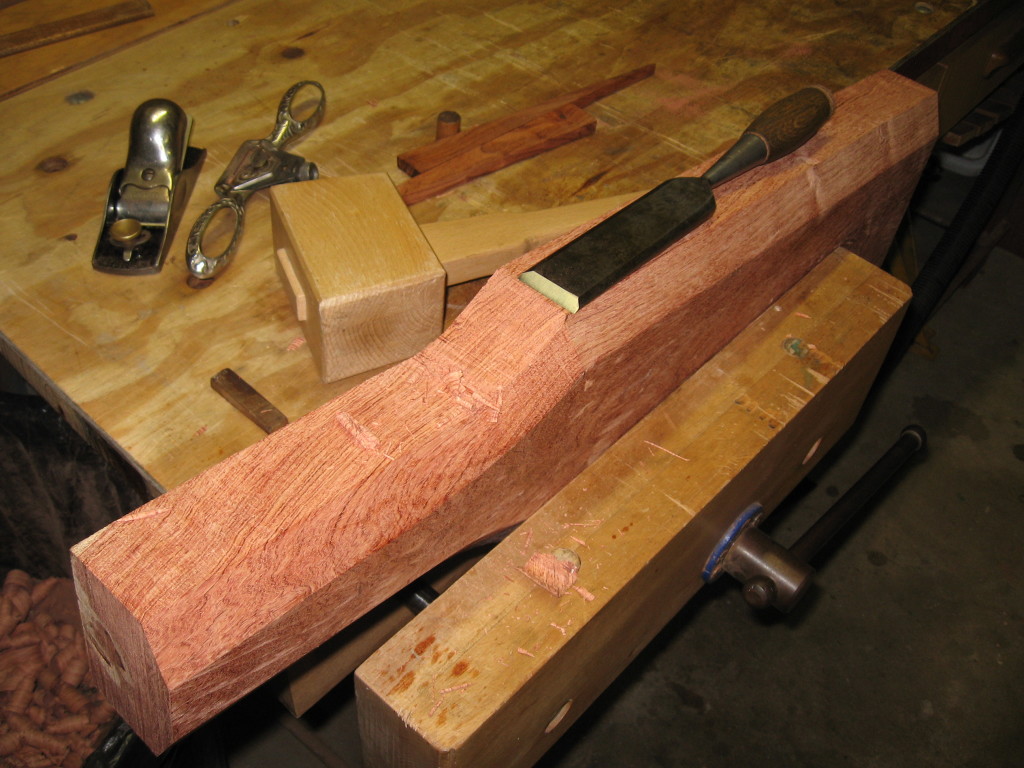
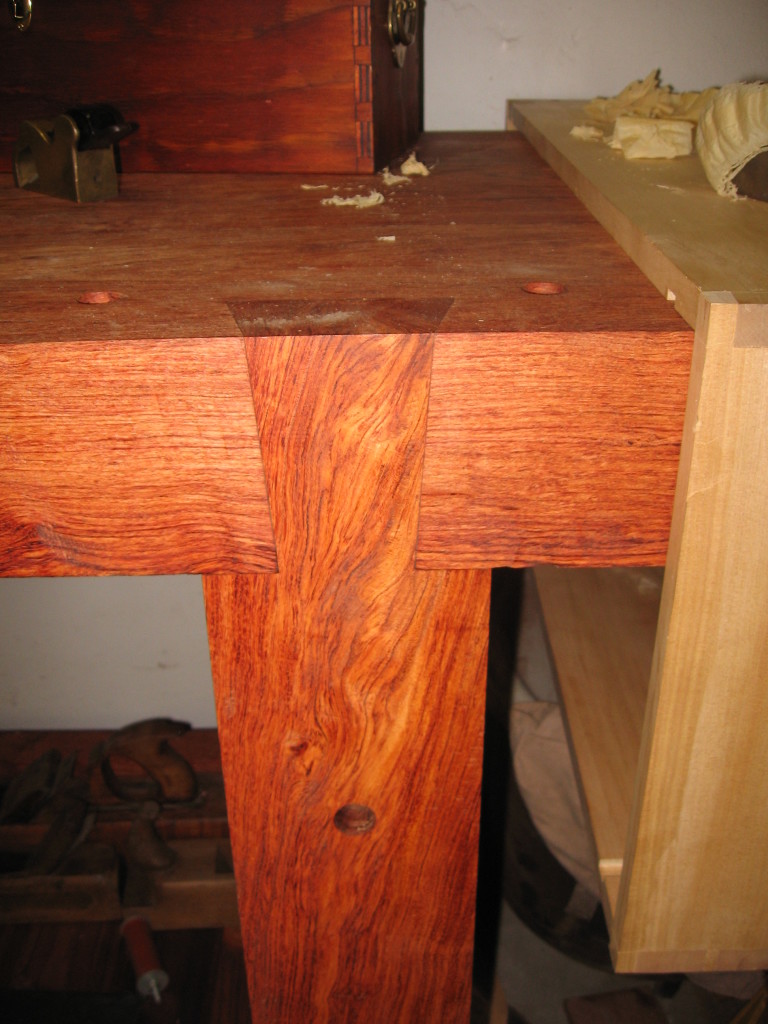
After the top glue-up, it was time for the leg top tenons. Decided (speciality factor) on rising dovetails (inspired by Roy Underhill, I think), which I knew was going to be fun and games in these large dimensions, all three cuts being taper cuts. To start the cut correctly, snugly next to the line on this tough hardwood, is really the key (second to the initial accurate measurements and marking, of course). Saw just wants to (and does) slip in the tough end grain. Chiselling to the line to aid the start (First Class cut),  helped with some of the cuts. If done carefully, minimal planing is required afterwards. Still, it is a workbench, so it doesn’t have to be perfect!! This timber weighs 800kg/m3 and has a Janka of 2090. I orientated the legs so that my cut would be more or less vertical using my sash. At that stage I still had trouble sawing accurately to a line, so I sawed 10mm at a time and then scrutinised my cut, until the cut was complete. Took forever, but the result, I felt, was acceptable. Had no room (read extra wood) for major errors. This is not necessarily a stronger or less stronger joint than the other traditional joints being used on Roubo. Just a bit of a fancy joint (for that x-factor aka je ne sais quoi!!) that I strived for to make the bench special. Also one of the joints the woodwork community calls “impossible joints”, because once assembled, it appears to have been impossible to assemble.
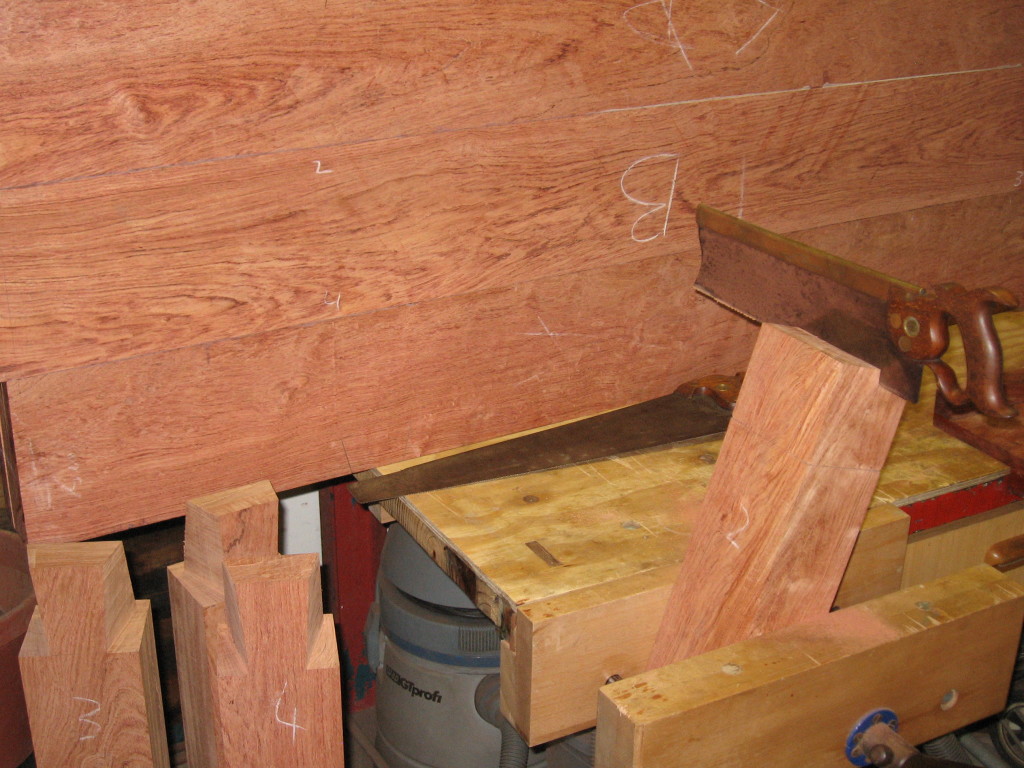
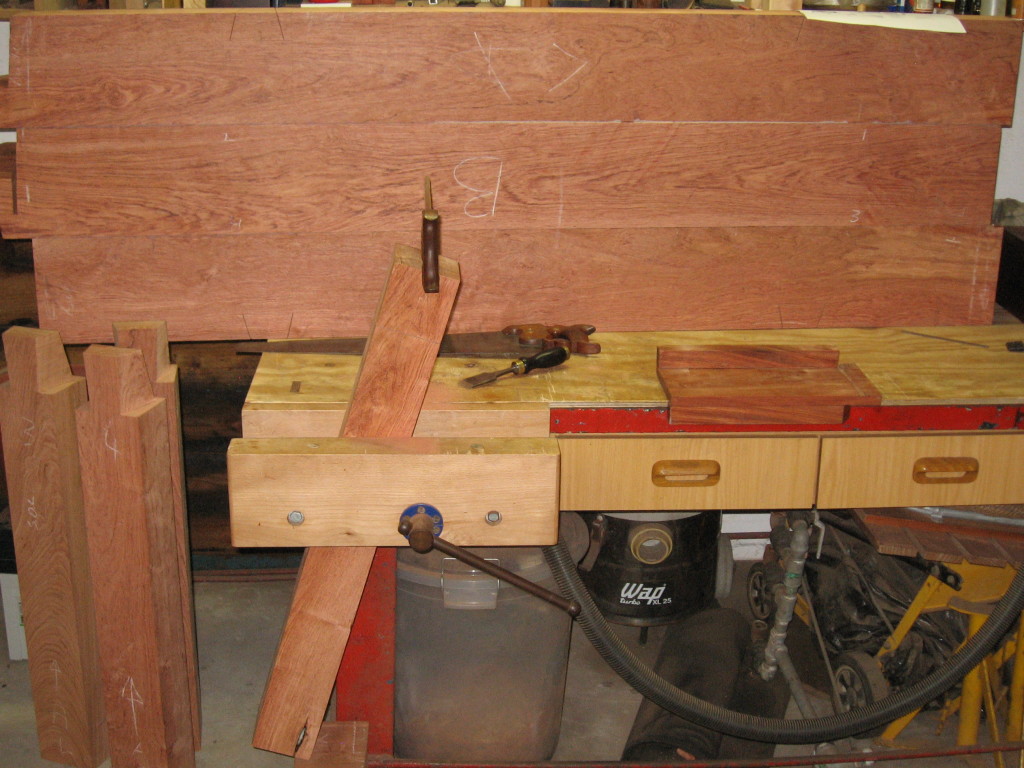
Roubo7 RDT pootRoubo8 RDT pootRoubo9 RDT pootRoubo10 RDT pootRoubo11 RDT pootRoubo12 RDT poot

Turning to the top 1800x600x100mm (72x24x4″)was ideal to test a recently restored 1″ Witherby, but I found it was almost too small for the job at hand.
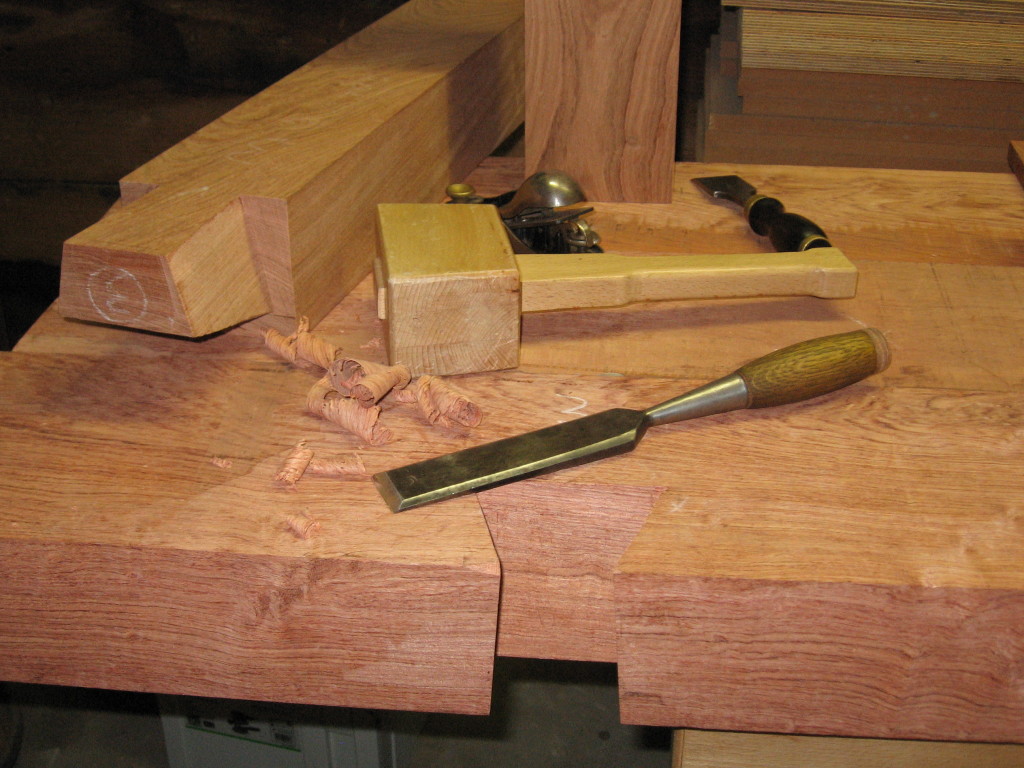
Roubo13 RDT blad

Then the horizontal supports.

Roubo14 poottap

With lapped dovetails in front.

Roubo15 spartapRoubo16 DT spartap

The jaw (200mm or 8″ wide) was also a challenge to shape with ordinary spoke shaves etc
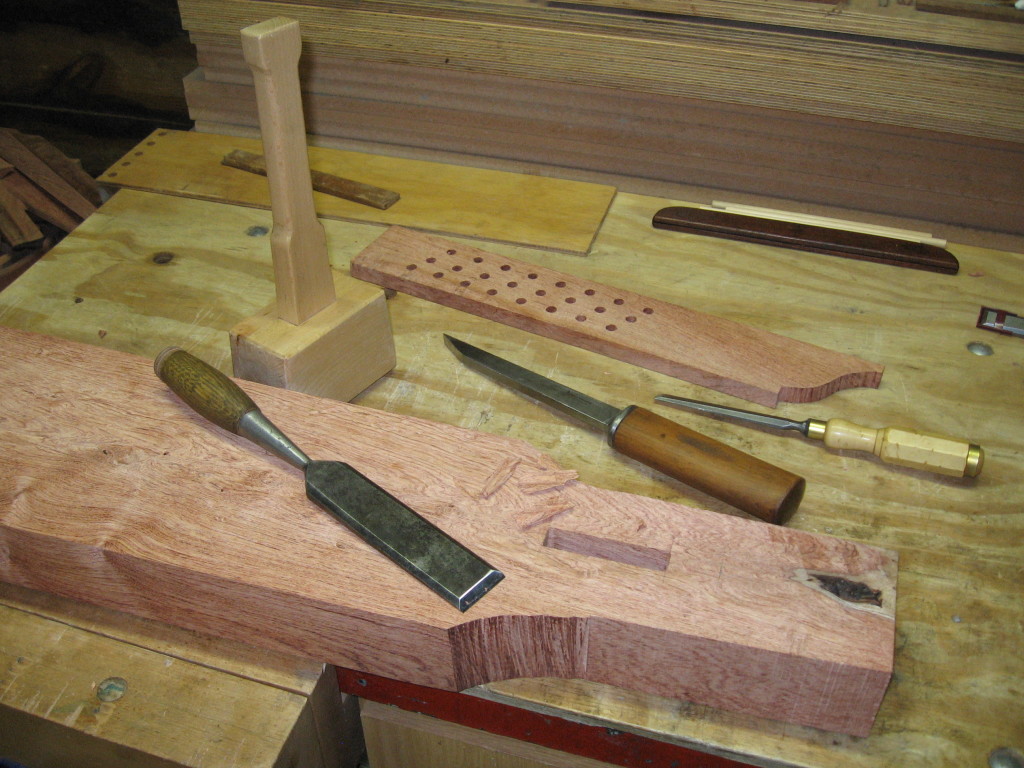
Roubo17 kaakRoubo18 kaak

Think these were sold as antique book clamps but they appeared acceptable to be used in the vise. Used the least chipped thread (almost 2 inches diameter) because there were some wear and tear on them. Not a nice tight fit on the female thread anymore after all these years but had to do. Using beeswax on them to reduce friction.

Roubo19 skroef draad

Something else that I found quite challenging was the glue-up because all the parts had to be simultaneously glued, fitted and clamped in the limited open time. Do you ever have enough clamps?? By the way, dry fitting (and disassembling) these tight fitting huge tenons was not a walk in the park either. Eventual result was fine though. Then used a caster wheel with a 6mm sawn off drill bit as axis to ease/support the vise operation. Also did something similar at the rear end of the vise (top of the tenon hole of course, in order to support leverage of the vise)
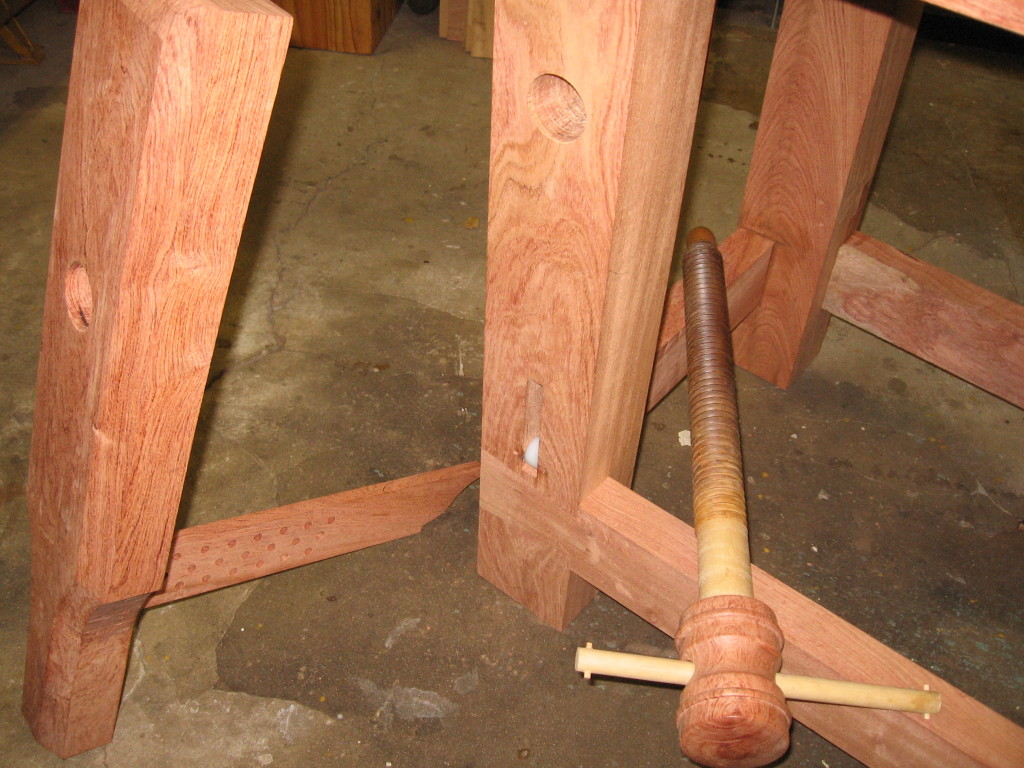
Roubo20 kaak glide

African Blackwood (Dalbergia melanoxylon) for the garter and handle knobs. Will probably inlay the garter later on (when I feel like acquiring inlaying skills!!)
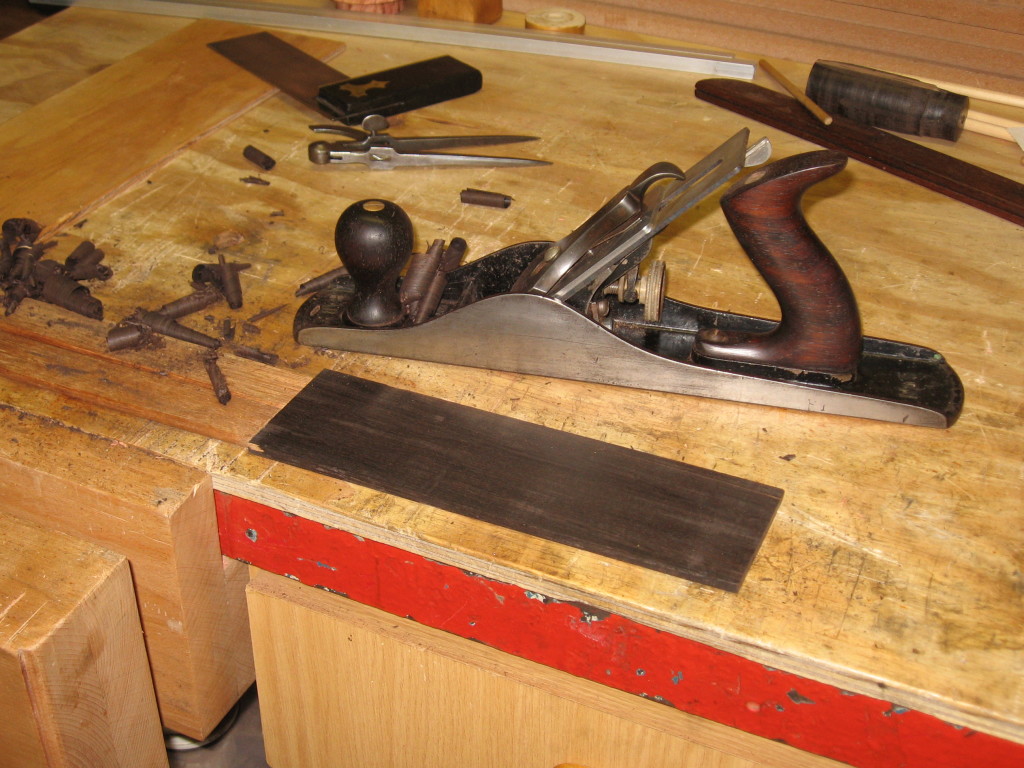
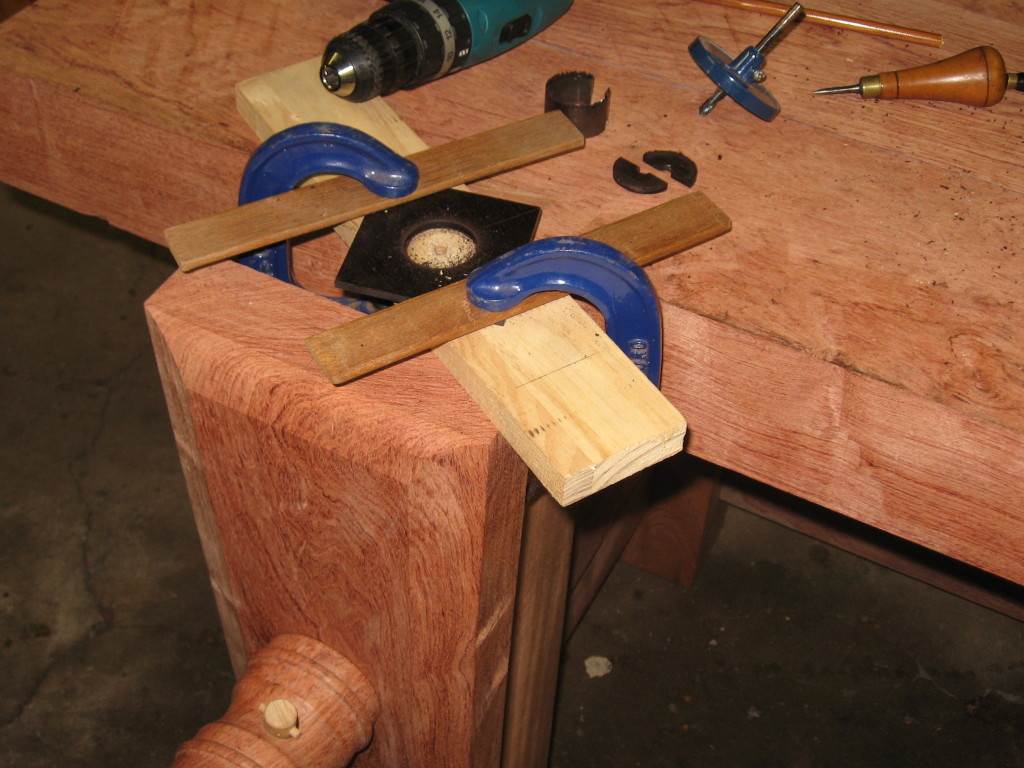
Roubo21 garterRoubo22 garter

And finally the tool rack that’s mounted to the left rear of the top. Will add additional bench dog holes etc as required. Didn’t want to start boring holes just to find out later on: “this hole actually needs to sit 1,357211cm to the left…”!!
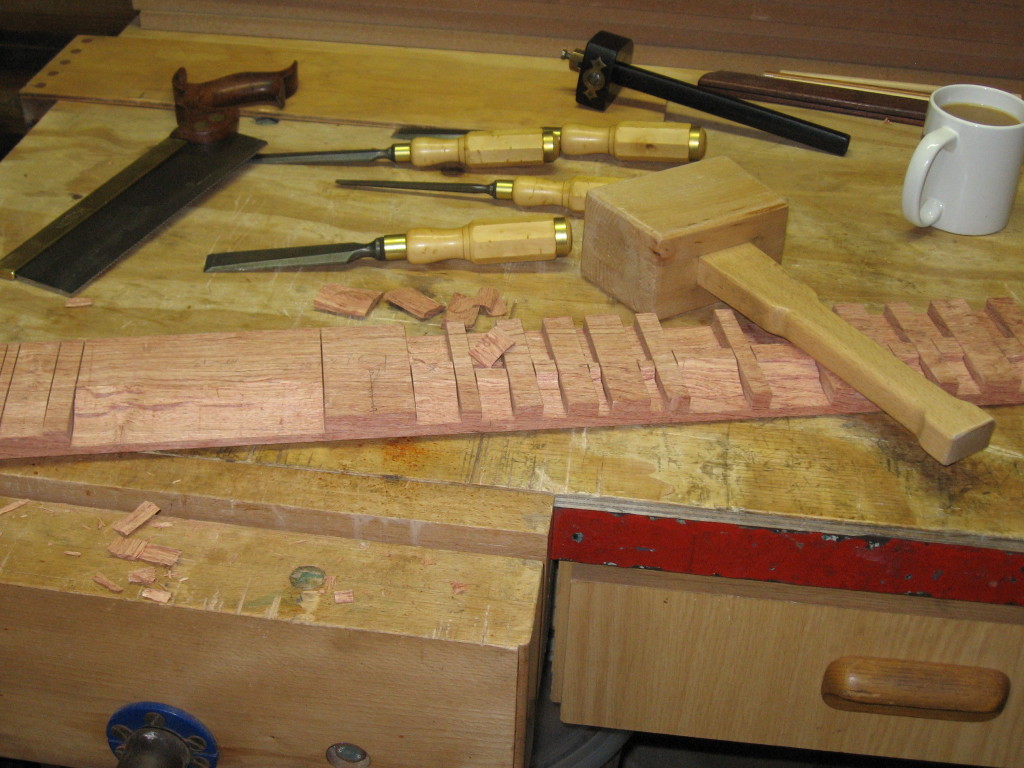
Roubo23 toolrak

Eventually, after flattening and some Danish Oil, voila!
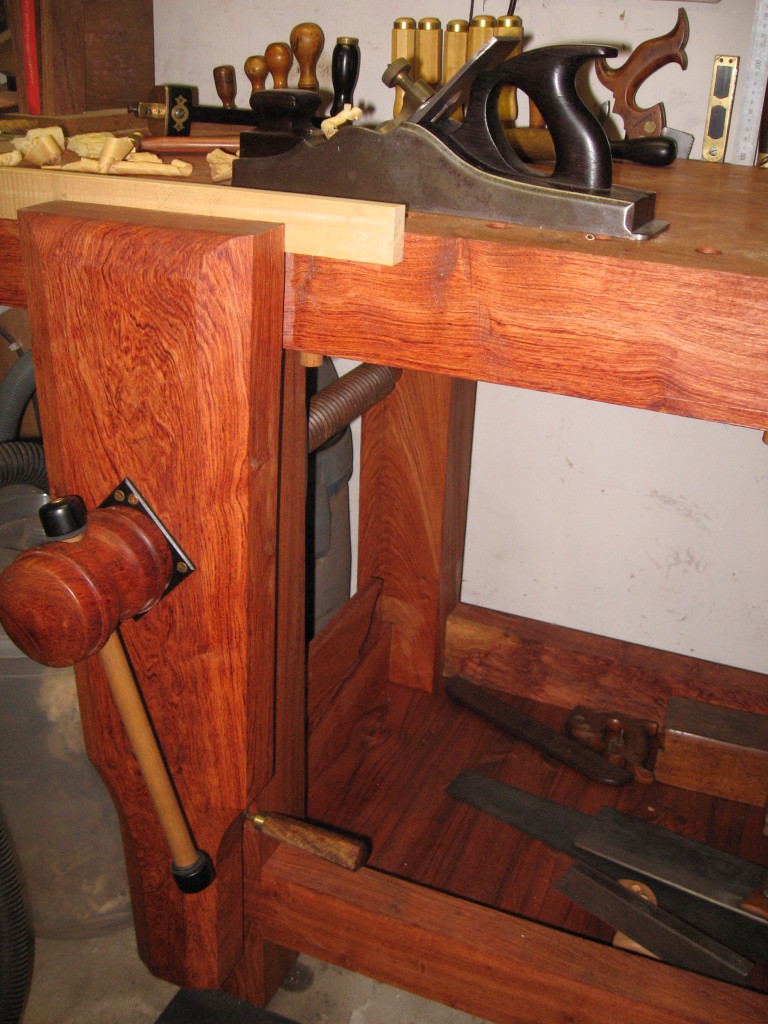
Roubo24 kaakRoubo25Roubo27 (1)

Some reminiscences…. After working with it for a few years now, I have no regrets (of course I would say that…). There’s nothing bothering or irking me. Every shop should have a solid workbench and by building one yourself, it teaches you lots of skills along the way. I like the size of my Roubo and adjust my work accordingly. The final height is 870mm (34,25inch) because I’m tall-ish. The darker wood works perfectly fine, although I think lighter wood may perhaps have been more practical. Would have liked more natural light in my cave though, but have to make do with extra artificial light. Would like to replace the vise screw sometime (with another wooden one) but at least this one is not jumping threads and actually works fine! I have added a traditional bench stop recently and drilled two or three extra holdfast holes. Thinking about a sliding dead man but haven’t really had the need to use one yet and there are other ways to circumvent that. Oh, yes, and then perhaps an end vise, even one with just a 20cm range span could also be a helpful feature. Personally I’d prefer not to bolt a Record 52 or something similar to the end of the bench to double up as ‘n end vise, but that’s purely personal. This thing weighs a ton, so I’m currently satisfied to use it just as it is. Saves a lot on medical bills, by not having to manipulate it (yet) for additional mods!

Hope I didn’t bore you with this African Roubo experience! Just thought many of you may relate to much of this.

Cape Town greetings!

Frank Bartlett

Aoife’s bed – part 3

11/4/2016

This is the final chapter in the series on building my daughter a bed from mostly reclaimed wood using Japanese joinery.

You can find the previous chapters here (part 1) and here (part 2).

As you might remember we only have the headboard left to do. Aoife’s has been using the actual bed since mid April. The piece of Cape Holly (Ilex mitis) below was deliberately left over after harvesting the straight grained part of the board for the shelve of my  second Roubo bench. I thought it could become an interesting headboard, especially with a bed that embraces Japanese traditions. The second picture below gives you an idea where these beautiful trees tends to grow in the wild.

IMG_6447image44

I made a bow using a strip of Assegaai and string. It enables you to experiment with different curves, which I did.

IMG_6448IMG_6449IMG_6450IMG_6452IMG_6453

I ended up with the below shape.

IMG_6454

The edges were smoothed off using hand planes.

IMG_6456IMG_6457

One of the issues (that I constantly complain of) in using such untamed stock is the amount of twist, bowing and cupping. In this particular case it was mostly twist. As you can imagine it is impossible to plane something like this either by hand or machine without destroying it. Yet it is of utmost importance to create two surface in the same plane where the posts of the headboard can be attached. My solution was this. I marked out two strips parallel to each other of exactly the same width as my Stanley no. 78 rabbet plane. Then removed the bulk of the waste by sawing and chiselling.

IMG_6458IMG_6459IMG_6460IMG_6461IMG_6463IMG_6464IMG_6466

The area was then flattened using the no. 78 to allow an accurate reading with my long winding sticks.

IMG_6467IMG_6470

As you can see in the second picture below the winding sticks revealed quite obvious twist, which was then removed with the help of the no. 78.

IMG_6475IMG_6474

My father was visiting at the time and he had the idea to burn the inside surfaces of the naturally shaped hole in the board to create an attractive colour contrast.

IMG_6483IMG_6484IMG_6485

I decided to stabilise the cracks using the famous Nakashima dovetail keys. I used a handsaw to produce these Kershout keys.

IMG_6491

As you can see below, the biggest of the keys looked a smidgen clunky so it was trimmed down a wee bit.

IMG_6487IMG_6488

After a quick readjustment of my sliding tool trays (you can read all about it here) the stock was secured to my bench’s chopping area by means of two holdfasts and a F-style clamp. This enabled me to fit the keys.

IMG_6492IMG_6493IMG_6494IMG_6495

Marking out it’s location.

IMG_6496IMG_6498

Removing waste.

IMG_6499IMG_6500

Chopping and detailed fitting.

IMG_6501IMG_6502IMG_6503IMG_6504

The depth was dialed in using this Stanley no. 271 router plane.

IMG_6507IMG_6508IMG_6509

Because it is literally impossible to plane this board I had to resort to a belt sander to create at least a few polished areas.

IMG_6514IMG_6515IMG_6517

As you can see in the picture below, a small piece of timber broke away (filled in with epoxy) from the side of the “mortise” as a result of the schizophrenogenic grain direction in this part of the board. Certainly not as a result of inferior skill levels, no. Seriously though, what I did learn from it was that this size of key (5 cm long and about 6 mm at it’s widest) is too small and thus difficult to produce an accurate mortise for in inebriated grain.

IMG_6516

A coat of Tung oil and turps brought out the the stunning side of the grain inebriation. The dull areas are those that were left unpolished. I thought these areas would come up much darker as it does with some of the other species I work with. The idea was that it would create more areas of visual interest, but then it only ended up dull. Another lesson for this woodworker.

IMG_6518IMG_6519IMG_6520IMG_6523IMG_6521IMG_6522

27/5/2016

That was followed by three coats of Woodoc. The photos below illustrate the attractive (I thought) colour contrast created by the burnt areas.

IMG_6530IMG_6531IMG_6532IMG_6535IMG_6536

30/5/2016

For the posts I milled stock from my stash of Scots pine to fit exactly in the dados at the back of the headboard.

IMG_6889

The posts were designed with curves to give the headboard an bit of a floating appearance. You can be the judge whether it worked or not.

IMG_6901IMG_6903IMG_6904IMG_6905IMG_6906

Aoife kept a close eye on proceedings.

IMG_6537

In order to strengthen the area of contorted timber floating inside the irregular hole I added two supports. This looks pretty sloppy although it is admittedly in an area were it should not be seen. However the nature of the grain and fragile connection to the main part of the headboard did not leave me with too many other options. Please let me know it someone has a better idea for future reference.

IMG_6910IMG_6912

I assembled the three components in the shop and then took it down to the house to fit to the bed.

IMG_6914IMG_6915

Here we go! The first proper piece of furniture for the house from my current shop.

IMG_6943

Aoife seemed fairly impressed.

IMG_6944IMG_6945IMG_6947IMG_6949IMG_6950IMG_6952IMG_6953IMG_6955

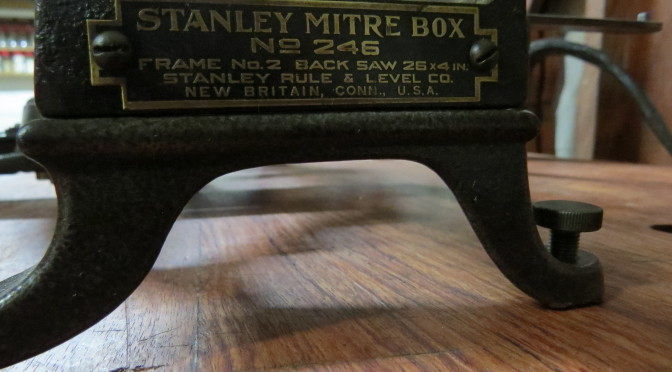
Stanley no. 246 Mitre box/saw restoration

26/5/2016

This is Frank Bartlett’s first post on Je ne sais quoi Woodworking. I hope it is the first of many as he is clearly a very talented woodworker and hand tool encyclopedia. I realise that I have an advantage in making that assessment as I have had the privilege to see some of the other projects he has done. Of course he gave me grief regarding the compliments, but I decided to leave it in the text as it is my honest assessment. So for now just trust me, you will come to enjoy his contribution to this site. Both Frank and I want to encourage other (especially African) woodworkers to become involved in this way. Feel free to contact me if you consider writing up some of your projects.

So without further ado, over to Frank Bartlett from the Cape of Storms:

Looking for an old mitre box had almost been an obsession of mine, for some time now (refer to Gerhard’s blog entry on his Langdon). But being in Africa, that is like looking for a needle in a haystack (suppose that is why Gerhard was (willingly) “forced” to turn to Jim Bode for his beautiful Langdon). I once saw a Stanley advertised up in the Free State, but it was one of those: “I know what its worth, make an offer….” ads, which is a pet hate of mine and which I’m not very good at. Needless to say, the seller didn’t bother to return my urgent emails after my offer! Anyway, that one went down the tubes although I still think my offer was fair given the condition.

So, after Gerhard’s notice that there may be one available on a 160km round trip, I had trouble sleeping that night, after reading through Bob Demers’ (The Valley Woodworker) prep of his box…. Anyway, eventually found the shop and there she was, at the entrance! Without a price…. Now, that could mean a few things, one of which of course, its not for sale. Which it turned out to be. After munchos small talk, the lady indicated she was keeping it as a rarity and furthermore, her son had told her on a previous occasion that he would like to have it. She also added that it “was very expensive anyway”. Turned out to be R900. For its condition I thought “eisch”, but presented the money (in small notes, and lots of them). The eyes lit up but nah, first wanted to contact her son to get his opinion. Fortunately for me, being in Africa, her son was somewhere out of cell phone range.

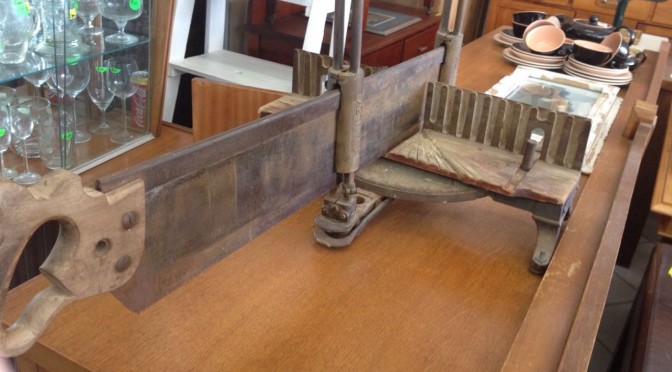
Paid up, grabbed and went for it. Must have been quite a sight walking with this (heavy) old thing merrily the odd six blocks (REALLY been looking for this shop…) because I turned not just a few heads. The photo below was taken in the antiques shop.

Stanley 246 1 (1)

Back at home I was able to scrutinise it thoroughly. Appears to be circa 1912-1916 model (because the length stop was only patented in 1916). Although there were a few parts missing, it was still surprisingly complete (most importantly missing the Disston medallion, trip clamp, one stock guide, one knurled tie bar screw and saw guide stop screw). Now these screws have really weird threads. So, not really critical components that I can get in due course.

Stanley 246 2Stanley 246 3Stanley 246 4

Once it was stripped and it was off to the wire wheel. I recently changed from a 1000rpm 5inch wheel to this 8 incher at 3500rpm on this 1930’s B&D. Whew! My fingers took quite a beating, not wanting to use gloves or pliers or vice grips on tiny (weird) threads… Unnerving experience, but tried to take as much care as I could (except for holding these things with my fingers)!

Stanley 246 5

On larger surface areas I prefer to use wire wool and turps and then clean it afterwards with White Spirit. The screws however, went the wire wheel way and was left bright and shining. To get an artificial patina back, I applied Birchwood Casey Gun Blue paste on the wire wheeled parts. Worked wonders. Afterwards the bottle of Boeshield T-9 was utilised because living in an area (where two oceans meet, nonetheless), rust is never far away. So, I tend to use this on tools or parts that I don’t get to oil regularly. For daily use on saw plates or planes etc, before storing them, I have a can of Jojoba oil handy.

Stanley 246 6Stanley 246 7Stanley 246 8Stanley 246 9

Then to the sacrificial frame board. I chose Cape Yellow wood  (Podocarpus latifolius or Geelhout) because its soft. Cape Yellow wood is probably the second most famous timber from South Africa (second only to Stinkhout or Ocotea bullata or Black Stinkwood). I first flattened the board and then jointed it. The last picture in the below set is a Podocarpus latifolius growing on the slopes of Table Mountain.

Stanley 246 10Stanley 246 10 1

Time then for sawing and pairing the rabbets for the stock guides (what is that Cape Boxwood handled Witherby doing so close to the edge, I’m asking myself now…)

Stanley 246 12Stanley 246 13

Drilling and forming the cutouts

Stanley 246 14

And there you go!

Stanley 246 15

Just some last thoughts on the 11ppi Disston saw. Apologies for not posting pics on the restoration, was just too exiting! Handle is flawless, especially after I doused it with Kramers Antique Improver. Teeth still cuts good but I still want to do the sharpening deed myself, just because..! Very little etch left unfortunately, no matter how careful I removed the rust (with turps, 400grit wet and dry, wrapped around a pad). There was just nothing left (not even the gun blueing/sandpaper trick worked). Very interesting, I saw on an old catalog that the box comes with a 26×4 inch saw, yet mine measures 24,5inches along the teeth. If you extrapolate the cutaway, you measure 26inches and 4 deep. I guess thats how they define the “26×4” on the brass plate.

Just one word of advice, this is a biggy and needs storing space, although it is difficult to store when you just want to look at it all day.

Cape Town greetings!

A new frontier for Je ne sais quoi woodworking

24/5/2016

Back in November 2015 a reader by the name of Frank Bartlett started commenting on my posts. It turns out that he hails from the Kavango in Northern Namibia where our fishing camp is. He currently resides in Cape Town and is an avid old tool collector/user. Since then we started corresponding with regards to good shops to visit to hunt for old tools in the former Cape Colony. He pointed me towards a few good ones in Cape Town and I returned the favour in terms of the same in the Garden Route.

After my post on the Langdon mitre box and saw, Frank indicated that he has long been looking for something similar in Southern Africa. I undertook to let him know if ever I stumble across one. In April of this year friends of mine (yes that is you Heidi) visited a few antique stores in the Cape Town area and took photos of a mitre box and saw, which they sent on to me. I immediately sent it on to Frank who went in search of the shop with very sketchy directions.

I do not want to elaborate too much more as Frank will probably do a better job of documenting the adventure. Anyway that got us thinking about a post on the restoration of this mitre box/saw. As we discussed it more we realised that I could actually create a category on my site where other woodworkers who does not want to blog full time  could post some of their projects.

Frank agreed to be the first guinea pig and has already sent me some photos of very interesting projects that might feature on Je ne sais quoi Woodworking in the near future.

Over to you Frank and watch this space to the rest of you.


Olienhout sector from the Groot Marico

18/4/2016

This project has been on my ‘to do’ list for at least two years. Ever since reading the seminal work “By hand & eye”, I just had to build a sector. It really is a magic wand in the shop once you understand a few basics of pre-industrial design methods.

During the Easter break I aquired this broken Danish boxwood rule for R35 (US$2.24) at an antiques shop. I have been looking for something like this for a while, as these rulers have the perfect type of hinge for a shop built sector.

IMG_6510IMG_6511IMG_6512

Seeing that one needs to mark out measurements on the sector, I decided to use a light coloured wood. I found this piece of Olienhout (Olea europaea africana or Wild olive) that would have been harvested between 1988 and 1992 on a farm in the Groot Marico district. My father was building Grandfather Clocks at the time and one of his best clients (as well as a personal friend) supplied him with Olienhout from his farm. This is a piece that was left over from that era.

I can still remember driving to Groot Marico with my father to deliver a Grandfather clock to this guy called Oom Frik. Oom Frik purchased at least four of these clocks over the years and paid for it in part by supplying my father with the most magnificent Olienhout. On the way there we stopped at the Hotel in Groot Marico to sample some of the local mampoer that the area is famous for. When the barman heard that it was my first visit to Groot Marico, he explained that it is custom for first time visitors to be served a glass of the local elixir on the house. Being a student at the time, I needed no further convincing so he proceeded to fill a tumbler with crushed ice followed by more than a sensible amount of mampoer.

That stuff knocked my socks off to say the least, despite being a fairly fit alcohol consumer at the time. As I sat there sipping the poison, I could swear Oom Schalk Lourens wispered something to me. For those of you who do not know the work of the legendary Herman Charles Bosman, do yourself a favour and read (at the very least) “Mafeking Road & other stories” (1947). It is arguably the best literature ever to come out of Southern Africa and it will make Groot Marico and the Afrikaner come alive to you. I digress, but as a last thought on the matter I will leave you with a quote from Bosman where he described Groot Marico “There is no other place I know that is so heavy with atmosphere, so strangely and darkly impregnated with that stuff of life that bears the authentic stamp of South Africa”.

Anyway this piece of wood comes from that area, has been lying around for at least 25 years since being harvested and was most definitely enjoying those beautiful Bosveld sunsets with Oom Schalk Lourence at the time Bosman was writing his epic stories.

IMG_6513IMG_6513

On the table saw I ripped 6 thin strips from the side with the lightest coloured wood. Two of those were milled down to the exact thickness of the boxwood rule.

IMG_6529IMG_6552

I then got rid of the broken hinges.

IMG_6553IMG_6554

I planed the boxwood very carefully to expose fresh wood for the adhesive to bind to.

IMG_6555IMG_6556IMG_6557

The strips of Olienhout were then glued up as so …

IMG_6558IMG_6559IMG_6560IMG_6561

After removing excess glue and squaring up, I had two extensions with perfect slots to accommodate the rule.

IMG_6583IMG_6584

The rule was then epoxied into position.

IMG_6585

16/5/2016

At this stage I first marked out the divisions on the inside surface of the arms. I decided on 25 mm divisions which gave me 24 of them on each arm of this sector.

IMG_6853IMG_6854IMG_6855

I then shaped the arms as shown below to make the sector lighter and enhance it’s visual appeal.

IMG_6856

A pin was added to help keep it straight and lined up while stored.

IMG_6857

I then marked the front faces using the inside markings as a reference. The numbers were punched in using my number set.

IMG_6858

Once punched I added black ink.

IMG_6860IMG_6861IMG_6862IMG_6863IMG_6864

That was followed by Woodoc finish.

IMG_6865IMG_6866IMG_6868

23/5/2016

There you go, one Olienhout sector from the world of the late great Herman Charles Bosman.

IMG_6874IMG_6875IMG_6876IMG_6877IMG_6878IMG_6879IMG_6880

Jonathan the Great

16/5/2016

We recently returned from a wonderful trip to Thailand and Hong Kong. Upon arrival at my practice I discovered two packages delivered from the US of A. One of them was a Peck, Stow & Wilcox slick that I bought from Jim Bode, so it was expected. The other turned out to be a present from my woodworking friend Jonathan White of the Bench Blog. Jonathan is famous for several things including the neatest shop in the history of woodworking and the so called “White milk bottle trick” (as apposed to the Charlesworth ruler trick).

It was incredibly humbling to receive such a present from a woodworking mate that I have never even met in person. It reminded me once again of the incredible camaraderie amongst the woodworking bloggers and the value of our online community. It is something that I have become increasingly aware of. My exposure to other woodworkers around the globe via their websites has inspired me to push my own boundaries.

Any way this post is not about me, it is about my first blog brother.

The parcel included this stunning marking gauge which Jonathan reconditioned himself. He wrote a post on the restoration, which is a riveting read. It is the most wonder tool you can ever imagine. The brass gives it that wonderful luxurious weight. The Ebony is absolutely flawless and shiny. Jonathan filed the pins in order for them to cut rather than scrape, which makes a world of difference then using the tool.

IMG_6831IMG_6832IMG_6833IMG_6834IMG_6839

He also sent me this set of bench dogs he made himself. If I am not mistaken it looks like Sapele. This set of dogs is J. White signature work. It is simply perfectly made.

IMG_6840IMG_6841

As you can see the face of the dog was cut at an angle, which is the type of attention to detail that one can expect from a craftsman of his statue. The face also features a perfectly cut piece of leather to improve grip and protect the your work from being marred.

IMG_6842

As you can see here they already did duty on my bench while working on a shop made sector (post to follow in the next few weeks). They work like a charm, I can tell.

IMG_6844IMG_6843IMG_6845

Jonathan thank you so very much, you are a legend mate. Thank you also for inspiring me and many other woodworkers to improve our work. It has been and will continue to be an absolute pleasure to correspond with you around this mutual passion of ours.

My second commission – part 4

31/3/2016

This past weekend I finally mustered enough courage to take on the Witpeer stock for the trapezoid leg of this table. You might remember the picture below, which is were I got to with these boards some weeks ago. The Witpeer (meaning white pear) is the light coloured wood at the top of the pile.

IMG_6348

On Friday afternoon I fed them to my electric planer, just to get rid of some of the nasty stuff. Of course the problem is that the planer does not get rid of any wist, bowing or cupping (length wise any).

IMG_6528

They then sat clamped to each other overnight, awaiting the major assault by hand plane the next day.

IMG_6534

Like most of these African wild timbers I mess around with, Witpeer is freaking hard. Therefore, if you have a serious amount of work to do like this, it is best to go into battle with razor sharp cutting edges. Now can you imagine anything better to do with your first cup of coffee on a Saturday morning than sharpening a couple of plane blades.

IMG_6538

First flattening the water stones.

IMG_6539

Then touch up the cutting edges.

IMG_6540IMG_6541

Two planes ready to rock.

IMG_6542

The first board was not too bad as you can see from the reading on my winding sticks.

IMG_6546IMG_6547

The next board unfortunately had at least 5 times more twist, which made me realise that I was a tad optimistic with the two planes I prepared. Clearly I needed to call upon the savage beast that is my shop made scrub plane.

IMG_6564IMG_6565IMG_6566

In the pictures below you can see the telltale scalloped appearance left by it’s heavily cambered blade.

IMG_6569IMG_6570

The extent of the wist in some of the boards necessitated the use of a wedge to stop it from wobbling all over the bench.

IMG_6568IMG_6567

It took the best part of 5 hours of hand planing to work my way through 7 boards on the Saturday morning. By the time I was finished all seven were marked as illustrated in the picture below. The flat (or face) side were marked as usual (bottom in picture) and the opposite side had scribble all over it to help identify when it is completely flat during the process of lazy planing (aka planing with an electric planer).

IMG_6548

Once the lazy planer did it’s damage, the boards looked like this. As you can see, the Witpeer has quite a few areas of visual interest. The cracks will eventually receive Nakashimaesque butterfly keys.

IMG_6571IMG_6572IMG_6573IMG_6574IMG_6575IMG_6576

Just to remind you of were this stock fit into the project I include two pictures of the prototype model. The stock that I am preparing will form one of three layers of timber that will ultimately make up the big solid trapezoid leg. The leg will have an overall thickness of 44 mm (therefore exactly double the thickness of the top of this table) of which this layer will make up 20 mm. It will be the timber you see when looking at the table from the end seen in the second picture.

IMG_6279IMG_6278

At this stage I had to quickly work out the exact measurements of the trapezoid leg using the prototype as my guide. It came to these numbers (in mm of course).

IMG_6578IMG_6577

Once I knew what to aim for I straightened one edge of each board by hand planing and used that as a reference surface to rip the other edge with the help of the table saw.

IMG_6579

After nearly two days I ended up with boards looking like this. This means that I am now just about at the stage were most woodworkers start their project. In other words with straight, square and wind free timber. The only difference is that apart from well prepared stock, I received some blisters and muscles on the house.

IMG_6582


Aoife’s bed – part 2

31/3/2016

Part one in this thrilling series can be found here.

The rabbet/rebate where the slats will be fastened to the long rails were cut on the table saw and cleaned up using my no. 78 Stanley rabbet plane. As you can probably deduct, I found this particular plane in a dilapidated state without a lever cap and lots of surface rust. It therefore received a complete rehab, which included the challenge of producing a custom lever cap fashioned out of brass (ala Lie-Nielsen) and a idiosyncratic lever cap screw. You can read the whole story here.

IMG_6380IMG_6381IMG_6382

Bed parts resting to fight another day.

IMG_6383

The future owner helped me to assemble the bed for the first time and it fitted together like a charm, first up.

IMG_6384IMG_6385IMG_6386IMG_6387

She clearly did not realise that we need to add a few more essential parts.

IMG_6388

Checking whether I have enough slats, before processing them further. As I mentioned before, this is Tasmanian Blackwood (born and raised in Africa) that was reclaimed from crates my father built several years ago to transport all his tools to me. Therefore it is clearly not the pristine stuff you would use for other parts, but will be doing the dirty work while hiding under a mattress anyway.

IMG_6389IMG_6391IMG_6390

I pulled out my shop made Jack plane (with it’s blade bedded at 50º) to square the slat stock up. The 50º bedding angle made planing the TB much easier as it tends to have schizophrenogenic grain direction.

IMG_6392IMG_6393

The Scots pine received a treatment of turps mixed with tung oil, followed by two coats of shellac, followed by three coats of Woodoc 5. The photos below were taken at some stage during the finishing process.

IMG_6394IMG_6395

Didi and Aoife helped to rub the surfaces down with 0000 steel wool between each coat.

IMG_6396IMG_6397

12/4/2016

I bought a 1969 MGB in Cape Town during the Easter weekend. It necessitated my father to help drive the other vehicle back to Windhoek as my wife ran the 56 km Two Oceans Ultra-marathon the day before we headed back. That pretty much took her out of the equation as a driver. We completed the 1600 km drive over two days as I did not want to push this grand old Lady too hard.

IMG_6399

Anyway, that meant that my father who got me interested in woodworking in the first place, had his first visit to my shop. Quite a few of the tools I am still using on a weekly basis used to serve him over many years in his shop. It was a wonderful privilege to work with him in my shop and show him what I have been up to over the past few years.

IMG_6423IMG_6424

Here we are drilling the pilot holes for the screws to fasten the slats into position in the rabbet mentioned earlier. We decided to drill the pilot holes at approximately 60º to ensure that the screws would pull the slat into the corner of the rabbet, while at the same time holding it down. I am not sure whether that is explained well, but it is the best I can do with my English.

IMG_6428IMG_6430

Wax on, wax off. One day the student becomes the master.

IMG_6434IMG_6435IMG_6437

Ready to screw the slats into place. If you have 12 slats you need 11 gaps between them. Therefore one way to work out what the size of the gap should be is to slide the slats to one side and divide the remaining space into 11 using your dividers. Once you know the size of the gap it is easy to cut two scrap blocks of wood to that measurement to use as spacers while screwing the slats into place.

IMG_6439IMG_6440IMG_6441

In the picture below you can see the two custom made spacers in action. I am working from left to right in the picture. The toolset for this particular job included a Millers Falls no. 2  hand drill (ca1938), Stanley Yankee no. 131 spiral ratchet screwdriver, some oil to lubricate the classic type wood screws, and the screws of course.

IMG_6442

One more coat of Woodoc by the Master himself and Bob Demers’ your Uncle.

IMG_6443IMG_6444IMG_6445

We will look at he process of making the headboard in the next instalment. Just to tickle your fancy, this is the piece of timber I chose for the headboard. It is a piece of Without (aka Cape Holly or Ilex mitis). The Afrikaans name is spelt the same as the English word without (obviously), but actually means white (wit) wood (hout).

IMG_6447