Category Archives: Handtools

Shop made Fidgenian Frame saw – part 1

20/4/2015

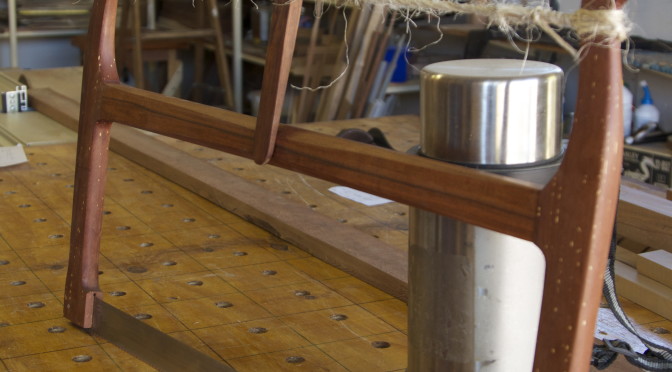
The next traditional saw on my list to build is a frame saw. You might remember that I have completed a 12″ bow saw and a 700 mm Roubo-esque cross cut bow saw already. After some research I decided to use Tom Fidgen’s (The Unplugged Woodshop) design as inspiration for my version. Tom is an icon of note as far as I am concern and that was enough reason for me. He produced two excellent videos on how he built his frame saw (see the link profided if you are interested.

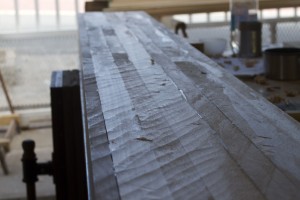
For this project I chose Kershout (Pterocelastrus tricuspidatus) which is ridiculously hard with a specific gravity of > 1 (it sinks in water). The third picture show the end grain of a small piece. I tried to count the year rings and got to about 120. This gives you an idea of how slow it grows and why it is so dense.

IMG_4133IMG_4134IMG_4137


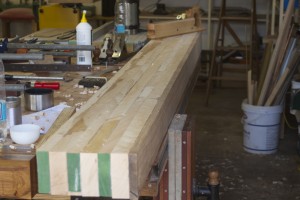
The usual lamination process I have to endure to make up stock with appropriate dimensions.

IMG_4146IMG_4147


The rough stock before work started.

IMG_4460


Living in Africa means I have to cobble together my own hardware for the saw. A scrap piece of mild steel angle iron seemed to fit the bill. As you can see I am no welder, but we all have our little problems.


IMG_4461IMG_4462IMG_4463IMG_4465IMG_4466IMG_4468IMG_4469


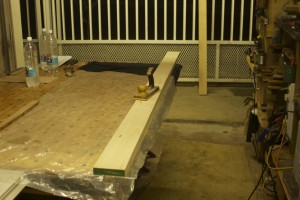
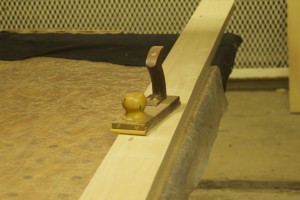
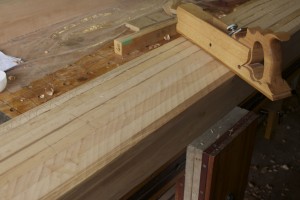
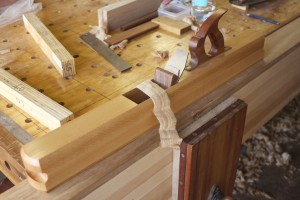
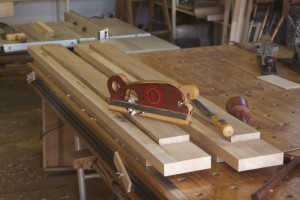
My shop built Jack plane came in handy to square up the parts.


IMG_4471IMG_4476


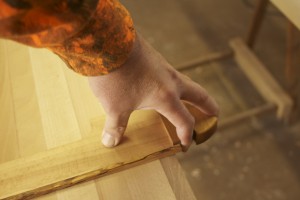
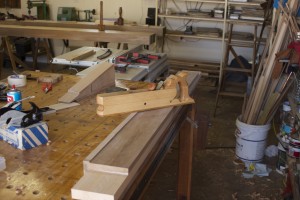
I have been struggling to saw off smaller pieces of stock like this perfectly square. Since I received my holdfasts I tried this approach and it improved my accuracy immensely being able to see the two lines you are sawing. You then flip it over and repeat on the other side.

IMG_4479IMG_4480IMG_4475


Dual tenon design, ala Mr. Fidgen.


IMG_4504IMG_4506


I like making a small notch with my chisel to start the crosscut saw.

IMG_4507IMG_4508IMG_4509IMG_4511


My shop made bow saw removed the waste between the two tenons.

IMG_4513IMG_4514


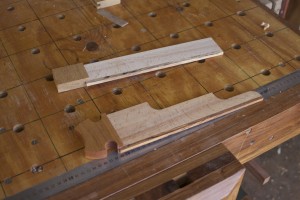
Dual tenons necessitates dual mortises.


IMG_4523IMG_4540IMG_4527IMG_4535


Now the fun part will start. Shaping the saw will be the topic of the next riveting installment in this series.

IMG_4544

Holdfast boots

18/5/2015

As self-proclaimed leader in the field of woodworking haute couture, I would like to introduce the next frontier in menuisier fashion. Last week the four Gramercy Tools holdfasts that I ordered arrived  after 5 weeks of traveling across time zones, an ocean and the equator. Holdfasts work like a charm, but tends to mar your work unless you stick a bit of scrap between it’s fangs and your stock. It can be a bit of a hassle so I thought of a way to address this particular issue.

I like to do leather work from time to time and it made sense to use this skill to alleviate the problem. As you can see in the pictures below, I custom-fitted these stunning Almond-toed leather booties to the business end of the holdfasts. I used two layers of Skeleton Coast seal skin for the sole and free range Namibian cow’s hide for the upper. It would not look out of place on a catwalk in Milan (says he), but I am not sure whether the common adage used to describe particularly sexy boots would necessarily apply. Apart from the obvious visual appeal, it has real functional advantages as well. It improves grip, protects your stock and cuts down the time spent fiddling with bits of scrap wood.

IMG_4444IMG_4445IMG_4447IMG_4446


I also took to the shaft section of the holdfasts with a rasps to improve it’s grip. It works like magic.

IMG_4450IMG_4451IMG_4448IMG_4449

Below you can find some examples of the boots in action. The pictures also provide ample evidence to support my decision to ignore Monsieur Schwarz’s Commandment to stick to very few dog/holdfast holes.

IMG_4452IMG_4453IMG_4454IMG_4455IMG_4518IMG_4524IMG_4528IMG_4540IMG_4535

Here are a few examples of a saw bench modeling the trend-setting footwear.

IMG_4456IMG_4457IMG_4458IMG_4487IMG_4488IMG_4491IMG_4492

My bench holdfasts live here.

IMG_4459


So there you have it, once again the best of tres chic woodworking. Only at Je ne sais quoi Woodworking.

Shop made Roubo-esque crosscut bow saw

13/4/2015

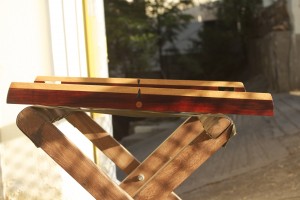
This is the second of a working set of bow saws that I am building at present. I decided to use Andre Roubo’s plates as inspiration for this one. If you are interested in this brilliant book by Lost Art Press, check it out here. The final picture in the series below is what I was aiming for.

IMG_4034IMG_4031IMG_4058

My bench while all this was going on.

IMG_4056

In terms of wood, I thought Assegaai (Curtisia dentata) would be perfect given it’s strength and resistance to splitting when flexed. In the pictures below you can see the pieces I selected. You might be able to see how the grain is running off to the side at one end of both pieces destined for the cheeks. I specifically chose it like this to follow the curve of the top end of the cheek, hence improving the strength.

IMG_4051IMG_4052

I used dividers to get a sense of the proportions of Roubo’s saw. One fixed measurement was the length of the saw blade (700 mm) as bought from Dieter Schmidt. I applied the proportions to this starting point to establish the length and width of the cheeks. In terms of the shape I simply drew something that followed the grain and added some artistic je ne sais quoi.

IMG_4057

I drilled and chopped the mortises in the cheeks prior to shaping.

IMG_4090IMG_4091

With the stretcher in position I marked out the correct location of the holes for the cross pin (6 mm or ¼” steel bolt in this case)

IMG_4059IMG_4060


20/4/2015

These holes were tapped and countersunk.

IMG_4092

Next step was to cut the kerf for the blade.

IMG_4085IMG_4087IMG_4089

I used the bandsaw to do the rough shaping.

IMG_4096IMG_4097IMG_4098

The lines to guide the next phase of shaping were drawn as shown, using my finger as a fence. It is quick and easy.

IMG_4099IMG_4100

The rest of the shaping were accomplished with spokeshaves, files and a card scraper.

IMG_4102IMG_4103

I used the same piece of Tamboti as mentioned in my previous post for the spindle of this saw. It was simply a bit bigger.

IMG_4105IMG_4113

A quick test fit. I really hope Brian Eve (Toolerable) does not get on my case again with regards to the string I used. I do not even know what this stuff is called, but it is cheap and available so that is what I went for.

IMG_4117IMG_4118

Tung oil treatment.

IMG_4119

Don’t you think Assegaai is exceptionally beautiful? I do. This saw hums through African hardwood. Viva Monsieur Roubo!!

IMG_4123IMG_4124IMG_4125IMG_4126IMG_4127

My next project will be a Fidgenian frame saw. The other saw I have built already is a 12″ bow saw. Go here if you want to take a look.

Shop made 12″ bow saw

13/4/2015

As you probably know by now, I am in the process of building a working set of frame/bow saws. For the small bow saw I decided on Witpeer (Apodytes dimidiata) to compliment the quality hardware from Gramercy tools. I also decided to use their design, as their reasoning for how they came up with their design made perfect sense, given all the other reading I did on the topic. This is a link to their plans. I found this discussion very helpful in terms of understanding the important design aspects.

In the picture below you can see how my new bench light made it much easier than before to chop the two tiny mortises in the cheeks after removing the bulk of the material by drilling.

IMG_4023IMG_4024IMG_4025

The rough shaping was done on the bandsaw.

IMG_4026IMG_4027IMG_4028

Just a quick reminder of what the hardware looks like.

IMG_4029

The rest of the shaping provided me with an ideal opportunity to use my new spokeshaves from Veritas. We were in Johannesburg over the Easter Weekend, which meant that I could do some shopping at the Hardware Centre in Randburg. They usually have bits and pieces of Veritas tools lying around.

IMG_4038IMG_4039

Sawing the tenons of the stretcher.

IMG_4040IMG_4041

IMG_4042IMG_4043

Shaping the stretcher.

IMG_4044IMG_4045

First fit.

IMG_4047

I then turned the handles and epoxied the brass pins into position.

IMG_4048IMG_4049

Fitting the handles.

IMG_4063IMG_4064IMG_4065

A picture to show what my bench looked like while building the first two bow saws.

IMG_4056

20/4/2015

For the spindle I found a Tamboti (Spirostachys africana) off-cut. This is as far as I am concerned one of the most precious African woods. If you want to know a bit more about Tamboti, use this link.

IMG_4104IMG_4105

It is very difficult to turn small pieces like this in my lathe. Therefore I decided to used the method illustrated below to turn the Tamboti spindle.

IMG_4106IMG_4107IMG_4108IMG_4109IMG_4110

I flattened two sides of the lower section with a block plane.

IMG_4111IMG_4112IMG_4114

The first assembly prior to finishing …

IMG_4115IMG_4116


… which was followed by a Tung oil treatment. You can also see some of the parts of my monster Roubo-esque crosscut bow saw these pictures. I will write a separate post on that project, which should be publish later this week.

IMG_4119IMG_4120

There you go … one 12″ Witpeer bow saw completed.

IMG_4128

I recently bought an old number/letter punch set and tried it out for the first time on this saw.

IMG_4129IMG_4130IMG_4131IMG_4132

The Roubo Beast Master (to steel a term from Mark ‘Bad Axe’ Harrell) crosscut bow saw is also finished.

PS – Thank you to my friend Jonathan White (The Bench Blog) who taught me how to insert links.


Building a working collection of bow saws – The hardware

16/1/2015

One of my key projects for 2015 will be to build a working collection of bow saws. I bought the big blades (700mm in length) below from Dieter Schmid in Germany. The plan is to build a Frame saw using the rip blade and a Roubo-esque crosscut bow saw with the crosscut blade.

IMG_0191IMG_0192IMG_0193IMG_0194IMG_0195

A few pictures of the crosscut saw I want to replicate loosely.  It can be found in Lost Art Press’  “Book of Plates”. I cannot say enough good thinks about Lost Art and their books. Every book is a seminal work in itself, which makes it impossible to decide on a favourite. Surgeons in my part of the world have a motto: “If in doubt, cut it out”. My motto with Lost Art Press books is: “If in doubt, buy it”.

IMG_4034IMG_4031IMG_4058

These little beauties came from Gramercy Tools. I plan to build a smaller (12″) bow saw using their design. I plan to use it mainly from removing waste material between dovetails.

IMG_2706IMG_2707IMG_2708

The wood for these saws is the pile on the right hand side. I chose Witpeer (Apodytes dimidiata or White pear in English) and Assegaai (Curtisia dentata).  Both these woods are extremely tough, hard and durable, which made it some of the favourites for Wagon building in the early Cape Colony. My supply comes from the Knysna evergreen forest, where I bought it more than 14 years ago.

IMG_3111

I will write separate posts on the construction of each saw. To check out the other posts:

12″ bow saw

Roubo-esque crosscut bow saw

Fidgenian Frame Saw – part one

Fidgenian Frame Saw – part two

Another tool ensemble from Jim Bode

20/3/2015

Last week I received a package from Jim Bode. This one only took 3 weeks to reach me as apposed to the previous (and first) one that took three months. If you are keen to find out what happened to that package read this post http://wp.me/p5S0Ig-1W3

You can check out Jim’s website, there is a link on my home page. I have only good things to say about their service. He usually hangs on to the stuff I buy until we have enough to justify a shipment across the Atlantic.

From right to left:

Yankee no. 135 quick-return screwdriver with 5 bits, I. Sorby pigsticker mortice chisel, Japanese carving axe, and a Yankee no. 41 push drill with 8 bits.

IMG_3465

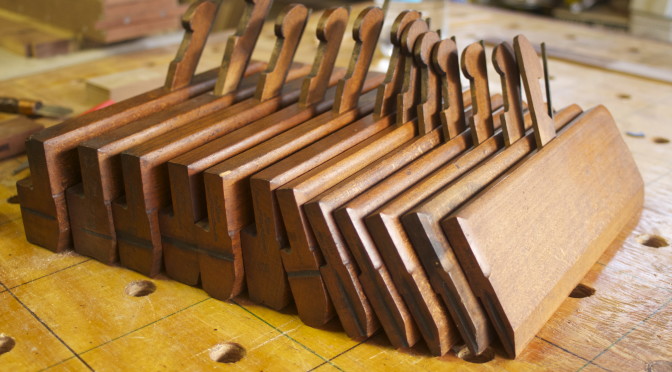
A perfect user ensemble of hollows and round by Sims (ca 1816-1834). These are incredibly well made and as good today as 200 years ago.

IMG_3462IMG_3463IMG_3464

Springbok and Seal leather sleeping bags

9/3/2015

In the pictures below you will see the collection of planes that reside on the shelve of my shop built workbench. There are quite a few shop made wooden planes, two Lie-Nielsen’s and the rest are all reconditioned old Stanley’s (nope, actually there is a Sargent too). In order to keep these planes from collecting too much debris, I am in the process of hand stitching comfy Springbok and Seal leather sleeping bags! Yes, I know this will probably mean that I (and my website) will be banned from any proper woodworking fraternity for the rest of my miserable life. On the upside I could become the Errol Arendz (South African reference) of woodworking couture. Yeah Baby!

IMG_3143IMG_3137IMG_3461

On the catwalk you may admire a beautiful shop made scrub plane dress in one of my exquisite creations. For some reason the phrase “je ne sais quoi” comes to mind.

IMG_3457

The silky Springbok leather keeps the plane from freezing to death in a shop that averages between 25 – 35°C (77 – 95 ºF). This is not called the Tropics for nothing. The virile Seal leather sole adds even more panache to the garment.

IMG_3458IMG_3459IMG_3460

Now wait for the eruption in the volatile world of du jour plane apparel …


The Old Warhorse

9/2/2015

I bought this Stanley no. 77 dowel machine from Jim Bode in October 2014. It took 3 months to reach me in Deep Dark Africa. If you are interested in reading the travel journal of the package it traveled in (absolutely riveting, by the way), check out this post:

http://www.jenesaisquoiwoodworking.com/protracted-tool-perambulations-through-sub-saharan-africa/

Anyway, this is one of the earlier models as the later versions were blue (rather than black). I am not sure in which year the colour change transpired. My came with a ¼” cutter.

IMG_3202IMG_3203IMG_3204

It has three oil holes (sure there must be a better term), that got fed this weekend.

IMG_3205IMG_3206IMG_3207

I found a piece of scrap wood that already had the correct dimensions to fix the main casting to. This enables me to quickly clamp it to the assembly table. When I need dowels.

IMG_3208IMG_3209IMG_3214IMG_3215IMG_3216IMG_3217

I first tried Ysterhout (Olea capensis macrocarpa), but this stuff is so hard and wild that even the old warhorse had trouble taming it. That was followed by beech, which were a lot more agreeable as you can see.

IMG_3210IMG_3211IMG_3212IMG_3213

Shop made beader

9/2/2015

… or at least that is what I think it should be called. I have been in the market for a beader for some time now. I found a nice pre-1900 Stanley no. 66 recently, but it is still hanging with Patrick Leach in the US of A. Patrick usually hangs on to my acquisitions until “critical mass is reached” (as he puts it) to justify a shipment.

This weekend I wanted to use beads to hide the fact that the two sliding deadmen I am currently working on are laminated. So I whipped this little guy together from some scrap Witels (Platylophus trifoliatus). I saw the design idea in a Fine Woodworking article (I think), a few years ago. It is armed with a Lie-Nielsen blade. According to LN, these blades will fit the Stanley no. 66. I will hopefully be able to report on that in the not too distant future.

As you can see, it did a sterling job.

IMG_3223IMG_3224IMG_3225IMG_3226IMG_3228IMG_3229IMG_3231

Shop made tools used in building my 18th century bench

5/2/2015

Seeing that my 18th century inspired bench is getting very close to being finished, I though it might be an interesting exercise to look at all the shop made tools that contributed to the final product. As you might know by now, I am based in Namibia. This means that I do not have the luxury of buying good quality woodworking tools from stores. At first it used to frustrate me with a vengeance, but over the past three years it became apparent that it is a blessing in disguise. Since I started building my own tools and restoring quality vintage tools, my learning curve went into overdrive.

Once you have managed to build (and to a lesser degree restored) a tool, you tend have a much better understanding of how it works. I also find it much more satisfying to use a shop built tool than any other.

So lets look at the lineup that helped me to build this bench. I simply picked photos from the 26 (at this stage) posts documenting the building process in superfluous detail. These posts are all entitled “My 18th Century Workbench in progress” followed by a number. I include links to posts I wrote on how each tool was built for in case you might want to take a closer look.

IMG_3093IMG_3094

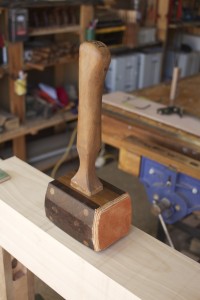
This is a shop made dowel plate and the mallet that did 90% of the damage needed to cut all the gargantuan through mortises.

http://www.jenesaisquoiwoodworking.com/its-a-dowel-plate-mate/

http://www.jenesaisquoiwoodworking.com/mallet-mania/

IMG_2380IMG_2381IMG_2280

This picture features a shop made wooden fore plane (right) and scrub plane (left). We will deal with the scrub plane later.

http://www.jenesaisquoiwoodworking.com/building-a-wooden-fore-plane/
IMG_2201

These sanding planes were used extensively during the tedious lamination phase.

http://www.jenesaisquoiwoodworking.com/proletarian-sanding-contrivances/

IMG_2106IMG_9879IMG_9880

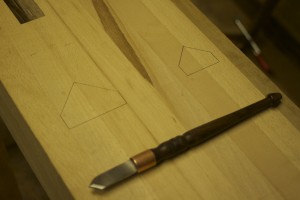
My version of a birdcage awl (right), which I fashioned out of an old centre bit. The marking knife was made using an old plane blade and a scrap piece of Tamboti.

http://www.jenesaisquoiwoodworking.com/brace-bit-birdcage-awl-also-known-as-bbba/

http://www.jenesaisquoiwoodworking.com/tamboti-and-witels-marking-knives/
IMG_2036IMG_2085

This is my heavy dead-blow mallet that was indispensable during the assembly of such massive joinery. It is also featured in the post entitled “Mallet Mania”

IMG_1894IMG_1672IMG_1673

This turned Assegaai mallet was employed for the majority of the fine-tuning that the joinery needed.

IMG_1931IMG_0395

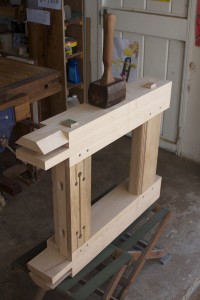
At this stage I have to say that this scrub plane is my favourite shop made tool. It absolutely mutilates (in a good sort of way) any excess material that needs prompt attention. It also comes in handy as an aggressive fore plane due to it’s length. If it was not for this warmonger, I would still be trying to flatten the two laminated beams that makes up the twin-top of the bench.

http://www.jenesaisquoiwoodworking.com/scrub-plane/
IMG_1918IMG_1922IMG_1442IMG_1443IMG_1459IMG_1463IMG_0006IMG_0007IMG_9954IMG_9957

A large shoulder plane with some je ne sais quoi.

http://www.jenesaisquoiwoodworking.com/building-a-wooden-shoulder-plane/
IMG_1763IMG_1764

This is my version of a Melencolia square.

http://www.jenesaisquoiwoodworking.com/shop-made-melencolia-square-with-the-marxian-improvement/
IMG_1735IMG_1739IMG_1740

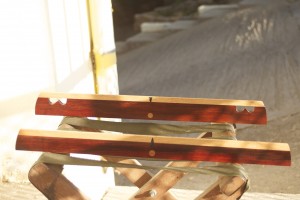
Winding sticks

http://www.jenesaisquoiwoodworking.com/shop-made-winding-sticks/
IMG_1493IMG_1495


In the pictures below you can see a wooden jointer and straight edge.

http://www.jenesaisquoiwoodworking.com/building-a-wooden-jointer/

http://www.jenesaisquoiwoodworking.com/shop-made-ysterhout-straight-edge/

IMG_2652

IMG_1440IMG_1421IMG_1422IMG_1423


This is my version of a panel gauge.

http://www.jenesaisquoiwoodworking.com/makeshift-panel-gauge/

IMG_1391IMG_1392IMG_1380


A few bench hooks.

IMG_0896IMG_0884


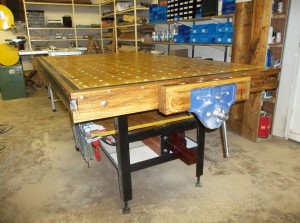
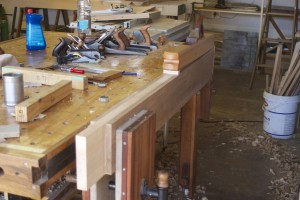
My assembly table was probably the most indispensable shop made tool in building the bench. In the the pictures below you will also see the legvise and sliding deadman I built to enhance the repertoire of the assembly table. I chose a few photos that illustrates how the assembly table made short work of otherwise tricky tasks.

http://www.jenesaisquoiwoodworking.com/alternative-workbenchassembly-table-chapter-one/

http://www.jenesaisquoiwoodworking.com/alternative-workbenchassembly-table-chapter-two/

http://www.jenesaisquoiwoodworking.com/alternative-workbenchassembly-table-chapter-three/

http://www.jenesaisquoiwoodworking.com/alternative-workbenchassembly-table-chapter-four/

http://www.jenesaisquoiwoodworking.com/alternative-workbenchassembly-table-chapter-five/
100_0293100_0285IMG_0875IMG_0877IMG_0878IMG_0879IMG_0880IMG_0886IMG_0384IMG_0233IMG_0241IMG_0239


http://www.jenesaisquoiwoodworking.com/legvise-with-a-twist-chapter-one/

http://www.jenesaisquoiwoodworking.com/legvise-with-a-twist-chapter-two/

http://www.jenesaisquoiwoodworking.com/legvise-with-a-twist-chapter-three/

http://www.jenesaisquoiwoodworking.com/sliding-deadman-with-a-twist/
IMG_0417IMG_0368


A flush plane

http://www.jenesaisquoiwoodworking.com/shameless-flush-plane-knockoff/

IMG_0362IMG_0142IMG_0143


Some shop made squares.

IMG_0281IMG_0289

I hope that this might inspire other novice woodworkers to build their shop and tools with their own shop made tools. It is a very satisfying journey.